

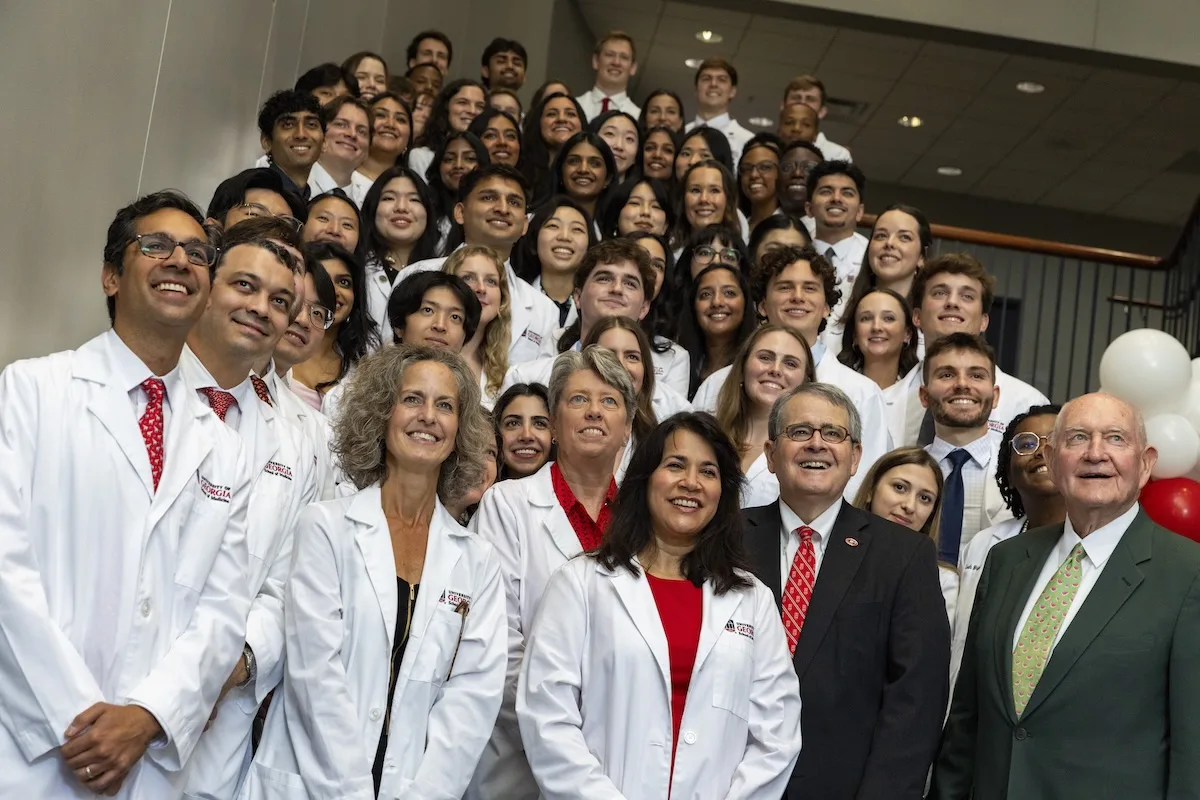
A new chapter in the University of Georgia’s history is underway as the UGA School of Medicine welcomes its inaugural class of 64 students.
Students in the inaugural class recently participated in their White Coat Ceremony, an important rite of passage for medical students signifying the beginning of their studies as medical professionals.
“You are the first Bulldog physicians in the history of medicine,” said Dr. Deep Shah, vice chairman of the University System of Georgia Board of Regents, during the ceremony. “You have honored the University of Georgia by selecting us to be where you choose to complete your medical education, and we hope you will return to practice medicine.”
The arrival of the first class marks the latest milestone in the development of the School of Medicine, which was authorized by the Board of Regents of the University System of Georgia in February of 2024.
Only two years later, the school received preliminary accreditation from the Liaison Committee on Medical Education, which cleared the way to recruit and enroll students.
And the interest from prospective students was overwhelming.
More than 2,000 applications were submitted during a condensed two-week admissions cycle, with 235 prospective students selected for interviews.
The 64 students who ultimately enrolled boast an average MCAT score of 514 and an average GPA of 3.85.
“Our inaugural class is an exceptional group of future physicians who embody the mission of the School of Medicine,” said Dean Shelley Nuss. “They are poised to become the physician leaders Georgia needs, and their impact will be felt for generations to come.”
The inaugural class, which includes seven first-generation students, also has deep ties to the state. Ninety-five percent of the students are Georgia residents, and approximately 80% earned their undergraduate degrees from in-state institutions.
Those connections to the state are central to the school’s mission to expand access to care and strengthen the physician workforce across the state, particularly in underserved communities.
The state is facing a lingering physician shortage and ranks 39th nationally in active patient care physicians per capita and 41st in public medical students per capita.
Before beginning their rigorous coursework, members of the inaugural class had the opportunity to learn firsthand the medical challenges facing Georgia as they embarked on a three-day tour across the state. Students met with providers and community leaders to learn about the specific health needs and challenges in different regions.
The students will begin their medical education by focusing on core medical competencies, including physiology, technology in medicine, systems-based practice, evidence-based medicine, team-based healthcare and medical ethics.
Students will gain early clinical experience by working with the Athens Free Clinic, a free and low-cost primary healthcare clinic established in 2018.
The inaugural class will also soon have full access to the school’s medical education and research building, which will open in December. The 93,000-square-foot facility will feature large active-learning classrooms, an anatomy lab, a simulation center, a clinical skills center and well-being spaces.