

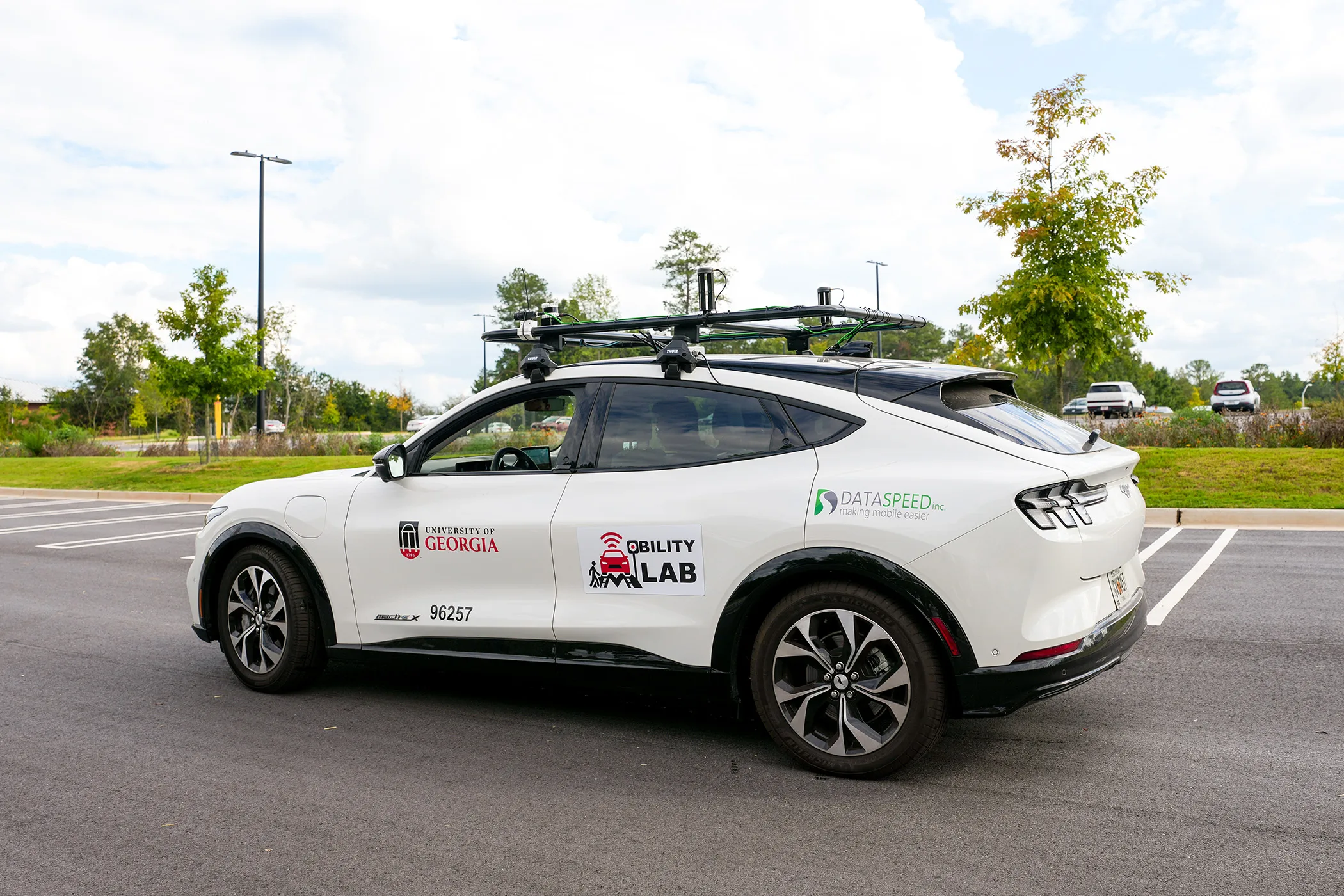
University of Georgia researchers are a key partner in a first-of-its-kind research center devoted to expanding access to autonomous vehicles in rural and tribal communities.
The Tribal and Rural Autonomous Vehicles for Efficiency, Livability and Safety — or TRAVELS Center — led by the University of Wisconsin-Madison is supported by a $15 million grant from the U.S. Department of Transportation and includes six collaborating institutions: Oklahoma State University, the University of Washington, Morgan State University, Northern Oklahoma College, University of Wisconsin-Milwaukee and the University of Georgia.
The project will provide UGA approximately $3.6 million in funding to bring the benefits of AV technology to rural Georgia, enhancing safety and efficiency. The project is supported by a strong interdisciplinary UGA research team featuring scholars with complementary expertise across transportation, infrastructure, perception, computing, communication and control. The team includes Handong Yao, Stephan Durham, Linbing Wang, Jidong Yang and Qianwen Li from civil engineering; Yunli Shao from mechanical engineering; Haijian Sun from electrical and computer engineering and Jin Sun from computer science.
“We are thrilled to partner with UW-Madison on this program, which will help accelerate the deployment of cutting-edge AV technologies in vast rural and tribal areas of the country,” said Handong Yao, the UGA team lead and assistant professor in the College of Engineering. “We look forward to applying our research toward innovative solutions to real-world challenges.”
More than one-fifth of Georgia’s population lives in rural areas where residents benefit from a relatively affordable cost of living but face significant transportation challenges. Nearly a quarter of all vehicle miles traveled by Georgia residents occur on rural roadways, which are among the most hazardous in the state. Georgia ranks fourth in the nation for fatalities on non-interstate rural roads, with 4% of rural roads in poor condition and 15% in mediocre condition, according to national transportation research nonprofit TRIP.
There are many barriers to transportation services in rural communities, including a lack of or limited availability of services such as public transit as well as physical infrastructure limitations and workforce shortages. The Georgia Department of Transportation reports that annual rural transit demand ranges from 0.56 million to 5.39 million trips, yet 29 counties have no transit services, and 66% of rural counties lack a regional or multi-county transit system. Additionally, 90.4% of transit agencies lack route-mapping data, making trip planning difficult.
TRAVELS aligns with Georgia’s rural development strategy through four integrated services:
- Digital Infrastructure and Road Enhancement for Connected Transportation, or DIRECT, will upgrade roads, signage and connectivity for safer travel.
- Healthcare and On-Demand Rapid Autonomous Vehicles, or HONR-AV, will provide 24/7 AV services for healthcare and emergency response.
- Cross-Jurisdiction Rural Economic Autonomous Transit, or CREAT, will improve regional transit connectivity across jurisdictions.
- Tourist and Event Autonomous Shuttles, or TEAS, will deploy AV shuttles and digital infrastructure for tourism and special events.
Together, these services aim to enhance rural mobility and safety while supporting economic growth.
Through TRAVELS, the UGA research team will collaborate with the six partner universities, 34 state transportation agencies and five key industry partners to reduce rural roadway fatalities, increase transit mobility and integrate advanced transportation technologies to enhance overall efficiency in rural Georgia.
“The University of Georgia is honored to be a part of this national effort and help lead the charge on AV research and applications,” said Stephan Durham, assistant dean for student success and outreach in UGA’s College of Engineering. “I’m confident this project is only the start of many other and larger projects in this growing field.”
The project began in March 2026 and will unfold in three phases: demonstration, deployment and enhancement.
Funding Agency: U.S. Department of Transportation. Project Title: Tribal & Rural Autonomous Vehicles for Efficiency, Livability and Safety (TRAVELS). Project Period: 2026.03-2032.02.