

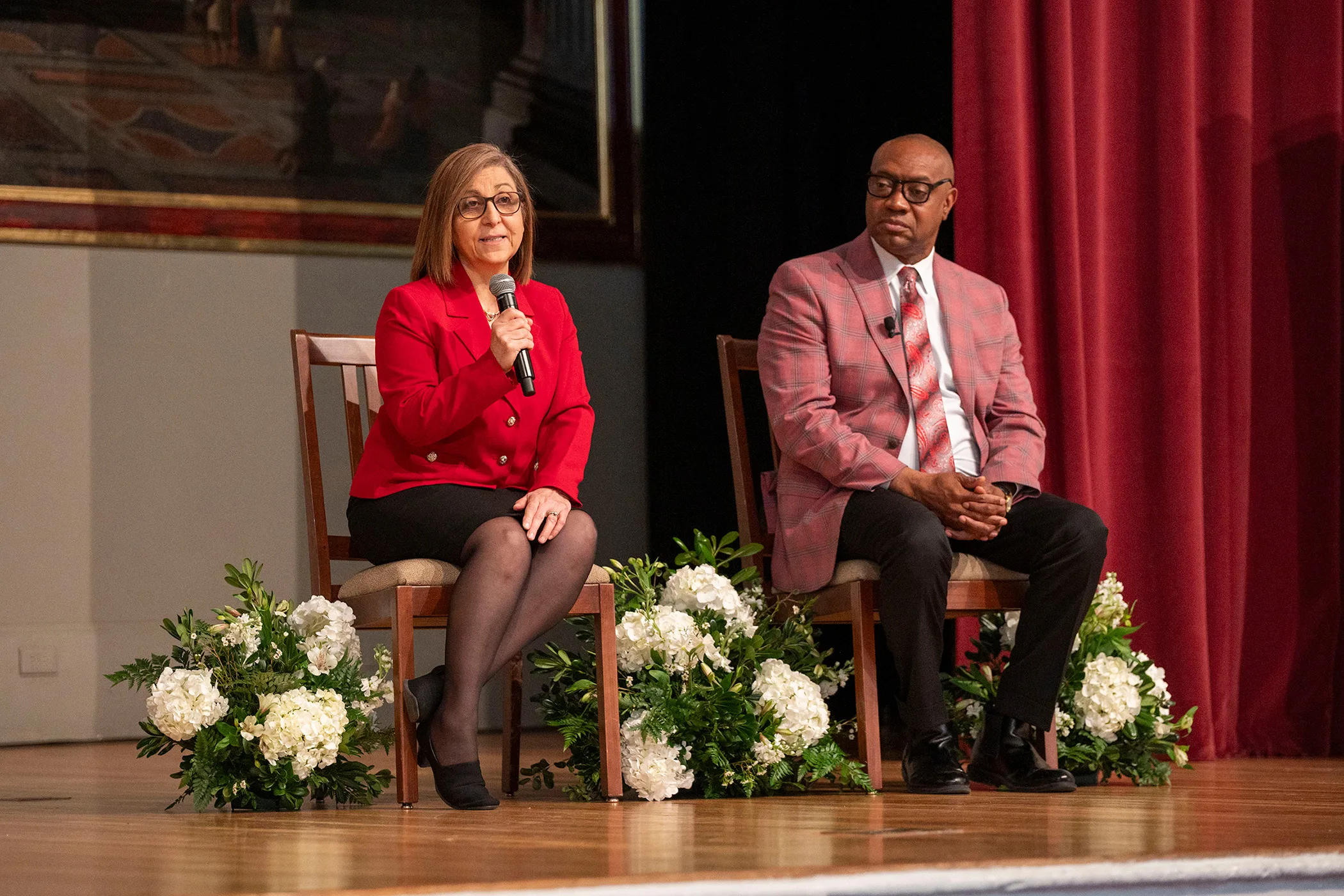
Two of the University of Georgia’s most distinguished scholars took the stage at the Chapel on March 25 to discuss the “mutual co-evolution” of humans and artificial intelligence and the rising risks of a more volatile global climate.
Elena Karahanna and J. Marshall Shepherd, the university’s newest Regents’ Professors, delivered the 2026 Charter Lecture, an event established in 1988 to honor the university’s founding ideals. The lecture highlighted how their research, spanning more than three decades, has progressed from theoretical inquiry to addressing urgent global challenges.
During his opening remarks, UGA President Jere W. Morehead congratulated Karahanna and Shepherd, noting “their scholarship is recognized both nationally and internationally as innovative and pace-setting.”
Karahanna, Distinguished Research Professor and C. Herman and Mary Virginia Terry Distinguished Chair in Business Administration in the Terry College of Business, traced her research through the evolution of technology from the desktop computers of the 1980s to today’s autonomous AI agents. She argued that the relationship between humans and information systems is no longer simply a matter of adoption but a co-evolutionary process in which technology reshapes cognition, interaction and work practices, and humans, in turn, shape what those technologies become.
“The question is no longer will we use technology,” Karahanna said. “The question is how do we design systems that shape us in ways we value.”
Her research also illuminates the “darker sides” of digital connectivity, including exhaustion caused by constant digital interruptions, the pull of excessive use and the ways online reviews can bias consumer judgment. She noted that as AI becomes a “cognitive partner,” she is investigating how to design systems that counteract human bias and preserve the collective knowledge processes that individual reliance on AI quietly threatens.
Shepherd, the Georgia Athletic Association Distinguished Professor of Geography and Atmospheric Sciences and an associate dean in the Franklin College of Arts and Sciences, followed with a talk about how his career began with a sixth-grade science project. He focused on the “so what” of his research, explaining how extreme weather acts as a “fundamental disruptor” to the global supply chain, public health and national security.
He highlighted his pioneering work on the urban rainfall effect, which demonstrates how cities can create or modify thunderstorms through heat, pollution and landscape disruption. Shepherd also discussed the brown ocean effect, a concept his research group developed to explain how hurricanes can maintain intensity over land by feeding on water vapor pulled from saturated soils.
“Hurricanes are no longer an issue only for Savannah or Tybee Island or St. Marys,” said Shepherd, pointing to billions of dollars in agricultural damage caused far inland by storms such as hurricanes Michael and Helene.
Beyond theory, Shepherd highlighted practical collaborations with the U.S. Navy and the insurance industry to assess risk associated with extreme weather events. He concluded by urging a shift from reactive disaster response to proactive resilience through his “Five R’s” framework of risk, response, resilience, remembering and recovery.
The Charter Lecture is hosted by the Office of the Senior Vice President for Academic Affairs and Provost. Since 2020, the lecture has served as a platform for the university’s most recent Regents’ Professors to discuss their scholarship and research. Provost Benjamin C. Ayers introduced the speakers, noting that their insights “resonate far beyond academia, influencing industry, policy and public understanding.”