

Sculpture, like architecture, is an invitation to marvel at shape, scale and human experience.
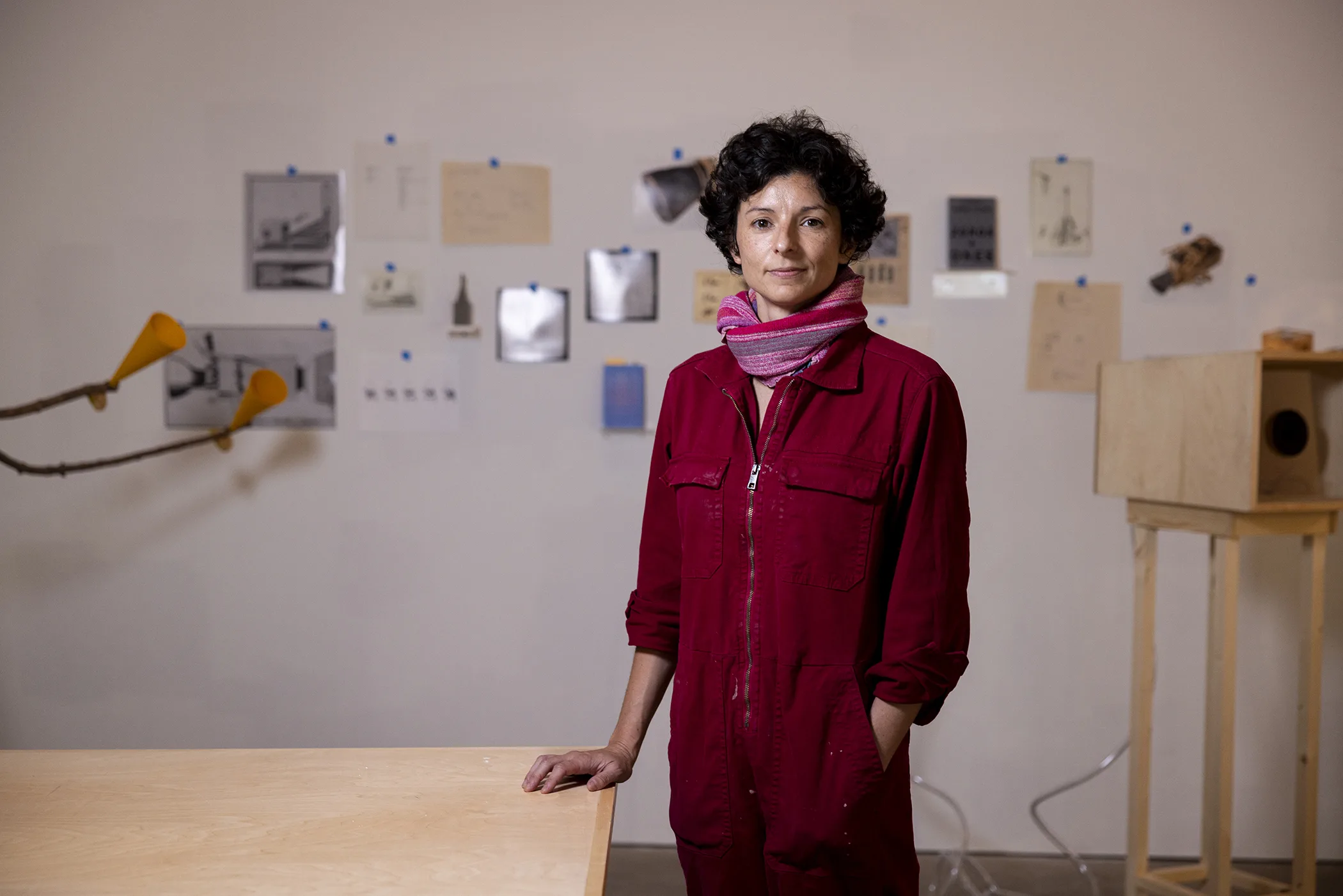
Kimberly Lyle, assistant professor of sculpture and technology in the Franklin College of Arts and Sciences’ Lamar Dodd School of Art, makes interactive artwork both by hand and digitally that welcomes audience participation.
“Many times, we ask art audiences to engage with work visually,” Lyle said. “I work with sound and touch; there’s an emotional and embodied aspect to it. I have artworks that invite participants to make rubbings on a table, breathe into a machine or enter a word into a sculpture.”
Lyle, who received the 2025 Innovation in AI Teaching Award at UGA, is driven by a curiosity for technological systems and language. Raised by an elementary Spanish language teacher and a middle school computer teacher, the connection between large language models (LLMs) in artificial intelligence and the playful, tactile lessons in a language classroom resonate in her work and teaching.
While her mother sang songs and made puppets to transmit fresh vocabulary to young minds, Lyle invites students to ask questions in their art practice about LLMs and AI voice assistance — how were these technologies developed, what values were woven into their function, and how do biases arise?
“There is no neutral technology, and AI is the same,” Lyle said.
For instance, modern AI voice assistants are built on datasets shaped by Western European phonetics and speech standards, a lineage that can be traced back to early mechanical speech experiments such as Wolfgang von Kempelen’s 18th-century speaking machine. The backbone of this dataset consequently produces less optimal results for other linguistic traditions.
Inspired by this broad line of questioning, drawing and painting student Violet Lustiano critically explored AI through the lens of plein air painting at the UGA Latin American Ethnobotanical Gardens for Lyle’s course. Lustiano conducted a unique experiment by first rendering a flowery painting by hand, then prompting ChatGPT to generate a similar digital painting by her own description and finally, asking ChatGPT for step-by-step instructions on how to paint the very same scene, so she could manually create the artwork per the AI directive.
Lustiano asked the class to match the three paintings to their source (human, ChatGPT generated, and ChatGPT instruction), prompting a lively class discussion on the limits of machine interpretation and simplification, especially when representing the complexities of plants and lived environments through gesture.
The world of artificial intelligence is experiencing exponential advancement as of late, leaving academics whose work intersects with it scrambling to keep up with upgrades and developments.
“You can become overwhelmed trying to keep up,” Lyle said. “I can use AI myself to see where holes exist and to find gaps. But I also have a growing awareness of the extractive human and environmental impact of data centers that power these systems and consider the ethics of using AI to question it.”
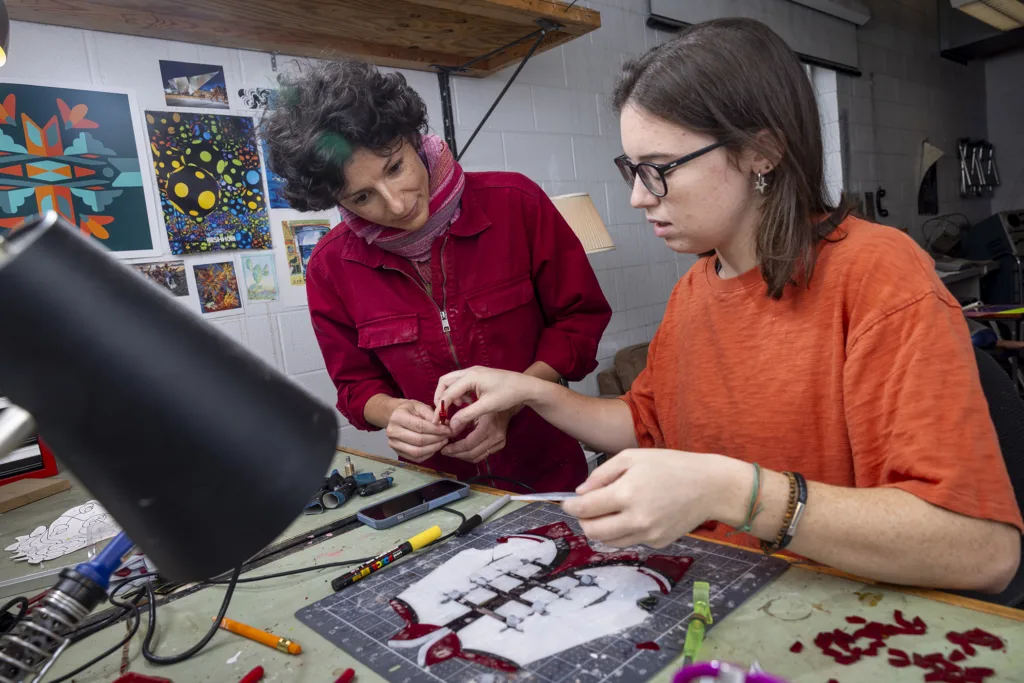
Lyle was hired a couple years ago under a UGA presidential hiring initiative that has grown faculty research at the university related to artificial intelligence. She credits Franklin College of Arts and Sciences research mixers, organized in part by Lamar Dodd School of Art colleague and associate professor of photography and expanded media Marni Shindelman, with planting the seeds for collaborative research with other areas on campus, including anthropology, conservation science and computer science.
A recent initiative at the School of Art titled “FLOW Lab: Facilitating Learning and Optimal Wellbeing Laboratory” was conceived by Lyle with professor of art education Mira Kallio-Tavin, assistant professor of physiology and pharmacology Dax Ovid and assistant professor of computer science Ari Schlesinger. Funded by a Franklin College Multidisciplinary Seed Grant, the FLOW Lab will be an educational space designated for neurodivergent students. Lyle, alongside students, will help guide the fabrication of the environment and shape its sensory elements, including lighting and sound that respond to individual sensory preferences.
Lyle credits UGA for keeping the arts in its sights regarding the future of artificial intelligence.
“I really appreciate that the university included voices from the arts as artists are rarely, if ever, sitting in the meetings where the tools actually get created,” Lyle said. “A lot of times, they might be undervalued in spaces of technological development, and I think recognizing that role of questioning and imagining differently in the beginning and not necessarily as an afterthought is meaningful.”
Events organized across campus with the AI faculty cohort explore conceptual and pragmatic implications of the technology.
“You know, the arts didn’t really ask for AI,” Lyle said jokingly. “But as artists, I believe it is our responsibility to engage with it critically, to disrupt its assumptions, and to imagine other ways we can be in relation to these systems — actively creating instead of passively consuming.”
Lyle added, “I think a lot of these other disciplines are trying to use it in ways that are very pragmatic. It’s been great to see, to consider its usefulness and being a voice of questioning in my approach.”
Within the School of Art, Lyle is accompanied by faculty members Ash Smith in photography and expanded media and Annika Kappenstein in graphic design in their investigations of AI on digital environments and media archaeology.
However, Lyle finds that the deeper she and the students dive into artificial intelligence, the more appealing the contrast of “natural intelligence” becomes. After all, artificial intelligence is centered on data, whereas natural intelligence considers the experiential, slow and earned joys of learning. Many of her students have been driven to volunteer at gardens, seeking community, connected, craft-based practices and the natural world. Amid our screen-based culture, these embodied encounters feel like medicine, Lyle argues.
Be it woodworking, metalworking, coding or 3-D modeling, Lyle’s central concern and reward as an educator is inspiring students to question the ever-changing world and imagine different ways of existing within it.