

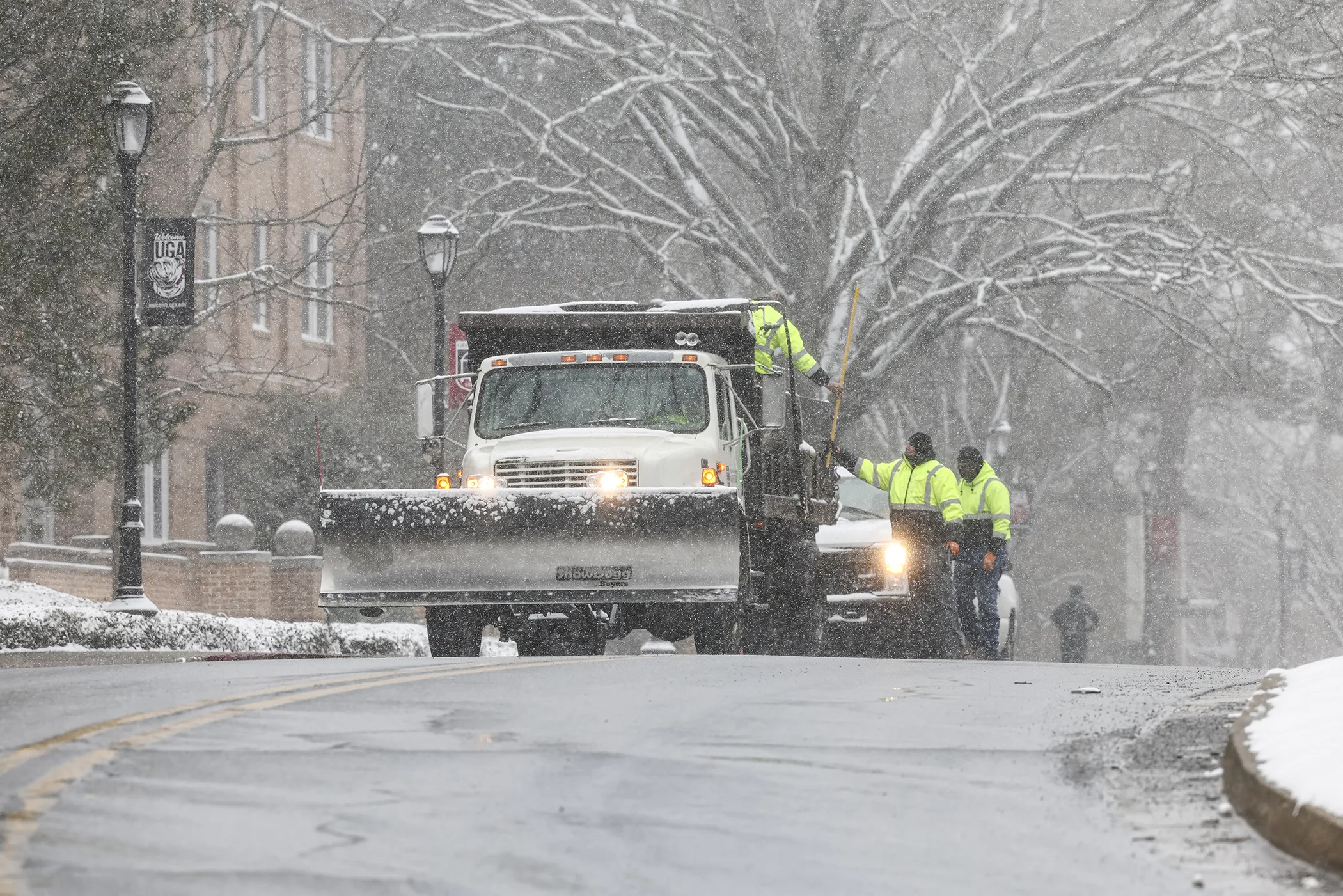
During the recent winter weather, units across the University of Georgia worked together to keep the campus community safe, warm and informed.
“I want to express my sincere gratitude for the hard work and selflessness displayed by so many members of our campus community in the face of recent winter weather,” said UGA President Jere W. Morehead. “Their actions over the past few weeks are truly inspirational, and highlight the University of Georgia’s long-standing commitment to the safety and well-being of our students, faculty and staff.”
The efforts started long before winter weather actually hit the Athens area. The Office of Emergency Preparedness began sharing reports with units likely to be affected after receiving forecasts of impending ice and snow.
“The dedication I’ve seen the last two weeks has been remarkable,” said Adam Fouche, interim associate vice president for environmental safety, risk and resiliency. “Many of our staff left their families two weekends in a row to make sure our students were safe and cared for and to support campus operations. All the planning, problem-solving and collaboration are what make our campus community exceptional. UGA is in incredibly good hands.”
Emergency Operations Centers (EOCs) were activated to help support campus operations. The EOCs allowed university officials to pull together stakeholders from across campus to plan and coordinate responses. That focus on planning and coordination was key to minimizing disruption to the campus, according to Fouche.
During the first weekend, which brought icy conditions to the area, the main concern was a potential loss of power, resulting in a loss of heat in campus buildings. Fouche worked with partners to source extra generators and other heating devices, including two generators from Georgia Power. These were stationed strategically across campus at locations such as the University of Georgia Center for Continuing Education & Hotel, the Tate Student Center, Ramsey Student Center, a few residence halls and the Bolton and Village Summit Dining Commons.
University Housing encouraged residents to go home that first weekend, if they were able, out of an abundance of caution. More than 100 resident assistant (RA) volunteers remained on campus to help those staying in Athens. University Housing also worked with OEP to ready shelter areas in case of extended power outages and prepared those generators. They readied a trailer of cots and developed an evacuation plan, should it be needed, with options for busing and walking students to shelter areas.
Several units within the Office of the Vice President for Finance and Administration played critical roles in keeping the campus safe and warm. The Facilities Management Division had 87 staff members working throughout the first weekend doing everything from clearing sidewalks to ensuring generators were running properly. A 40-person team from the Grounds Department and Auto Center treated 15 miles of roads, 8 miles of sidewalks and 5 acres of parking lots. They distributed 18 tons of ice melt to treat sidewalks, as well as 45 tons of gravel and 20 tons of salt to treat roads and parking lots.
Transportation and Parking Services readied buses to use as potential warming stations, if needed, and strategically placed buses around campus to support the transportation needs of those on campus. They also salted bus stops, stairwells and driving aisles and other areas before, during and after the storm.
Workers for Dining Services kept dining commons open and prepared to serve cold meals and grill outside in the event of power outages. They also provided “Bulldog Boxes” to any student upon request so they could take food back to their residence halls in case weather conditions prevented them from getting to a dining commons for their next meal.
Crews also took care of the Health Sciences Campus, ensuring the area was prepared if it lost electricity, which included providing boxed meals.
Additionally, the UGA Police Department worked with other groups across campus to assist where needed.
“The UGA police role in this and all similar events cannot be overstated. They are always here, and not only do their regular job, but they also act as the 24/7 eyes and ears of the university to help make informed decisions,” said P. Daniel Silk, the university’s associate vice president for public safety.
Keeping those workers safe was also a priority. The Georgia Center, a public service and outreach unit, served as a central location for operations during both storms. Around 100 essential workers from FMD, Auxiliary Services, the UGA PD and other units stayed at the hotel to allow for easier access to keep essential services up and running. They were also able to eat at open dining commons for free.
Preparations for the second weekend of winter weather were similar, although the concerns were slightly different. Instead of icy precipitation, Athens was blanketed with roughly 3 inches of snow, and preparations were made for extremely cold temperatures. Crews from across campus were out Jan. 31 and Feb. 1, allowing on-campus students to safely enjoy a rare snow day. Their work also allowed attendees to enjoy weekend athletic events and the Performing Arts Center’s 30th anniversary gala featuring cellist Yo-Yo Ma, while ensuring the campus was safe for faculty, staff and students to return on Feb. 2.