


Robert Jones often meets with aspiring academics who hope to build careers in higher education. Sometimes, they say something that gives him pause: “I want to do what you do. I want to be a university president.”
When that happens, Jones MS ’75, the president of the University of Washington, is already prepared with a response.
“Why do you want to do that?”
Before they can respond, Jones offers advice: “If you want to be a university leader, first of all, prepare yourself academically to be the best professor, best teacher, best scholar, best university community member that you can be,” he says. “And then see where that takes you.”
The theme is clear: Put in the work.
Hard work is a habit Jones has practiced his entire life. His efforts have paid off. Now leading a tier 1 research university for a second time, Jones is one of the country’s most accomplished leaders in higher education. But in some ways, he is just getting started.
A Career on the Rise
Jones was born in Dawson, Georgia, about 20 minutes northwest of Albany. Neither of his parents graduated high school, but they prioritized their son’s education. He embraced learning, even earning the nickname “professor” from his ninth-grade vocational agriculture teacher.
Jones became the first member of his family to attend college and graduated with a degree in agronomy from Fort Valley State College (now University). He then set his sights on graduate school in Athens because he wanted to learn from UGA faculty.
“I felt very fortunate to be able to come into a university with the reputation and the caliber of research excellence like that of the University of Georgia,” says Jones, who earned a master’s degree in crop physiology in the College of Agricultural and Environmental Sciences.
He credits the mentorship of Harold Brown, now professor emeritus of crop and soil sciences, and the late agronomy professor Doyle Ashley as crucial to his development as a scholar.
“I knew I wanted to be a laboratory scientist, I knew I wanted to work under the tutelage of the best people in the country, and I learned a lot from those two gentlemen,” Jones says.
Following doctoral work at the University of Missouri, Jones joined the faculty at the University of Minnesota. It was in the Twin Cities where Jones was drawn into administration.
Beyond just understanding the nuts and bolts of university operations, Jones realized that he enjoyed helping scholars navigate the complexities of academia.
“You get satisfaction out of providing access and affordability to students whose families can’t afford to pay for an education and helping professors start their careers and be successful by getting promotion and tenure,” he says. “So there are a lot of things that I find to be equally gratifying and satisfying in my administrative responsibility.”
Otherwise, Jones says, he would have just stayed in his lab, the place where he was most comfortable. He conducted groundbreaking research to develop more resilient corn plants and used molecular approaches to make major crops more heat- and drought-tolerant.
But once he decided to travel the administrator’s path, Jones rose quickly, eventually serving as Minnesota’s senior vice president for administration.
Over 34 years, Jones built a life in Minnesota. He gave back to the community by founding the Urban Research and Outreach-Engagement Center, now one of UM’s most impactful community partnerships. The center was named in Jones’ honor in 2015.
He and his wife, Dr. Lynn Hassan Jones, a radiologist, share five children. He also sang with the St. Paul-based Grammy-winning gospel group The Sounds of Blackness, which recorded with local luminaries like Prince, and Jimmy Jam and Terry Lewis.
Jones had many reasons to finish his career in Minnesota. But he was ready for a new challenge. He found one soon enough.
A President in Office
In 2013, Jones was hired as president of the State University of New York at Albany. It would be his first experience outside a land-grant institution, but he wasn’t fazed. In just three years, Jones led the largest academic expansion in the university’s history, helping launch two academic units.
His accomplishments caught the attention of the University of Illinois, which hired him in 2016. At Illinois, he oversaw a $2.7 billion fundraising campaign; launched an innovative medical school that combined engineering, data science, and clinical care; and expanded his leadership portfolio. He chaired the boards of the Association of American Universities and the Association of Public and Land-Grant Universities, as well as the Big Ten Council of Presidents and Chancellors, becoming one of the country’s most influential academic administrators.
It was hard work, and after nine years at the helm, Jones was ready to step away. But he wasn’t sure what he wanted to do next. Jones didn’t anticipate taking on the presidency at another institution, but the opportunity at Washington was too appealing to pass up.
Bulldog to Husky and Back
“Washington is an absolutely amazing university. From day one, I could feel the energy, the purpose, and the pride that infuses it,” says Jones, who began his tenure as UW’s 34th president on Aug. 1, 2025. He notes UW’s proximity to the 12 Fortune 500 companies headquartered in Seattle and the university’s leadership of a four-state medical school consortium among the highlights.
“A college education today is as vital as it’s ever been,” Jones says. “We need to talk more about its impact.”
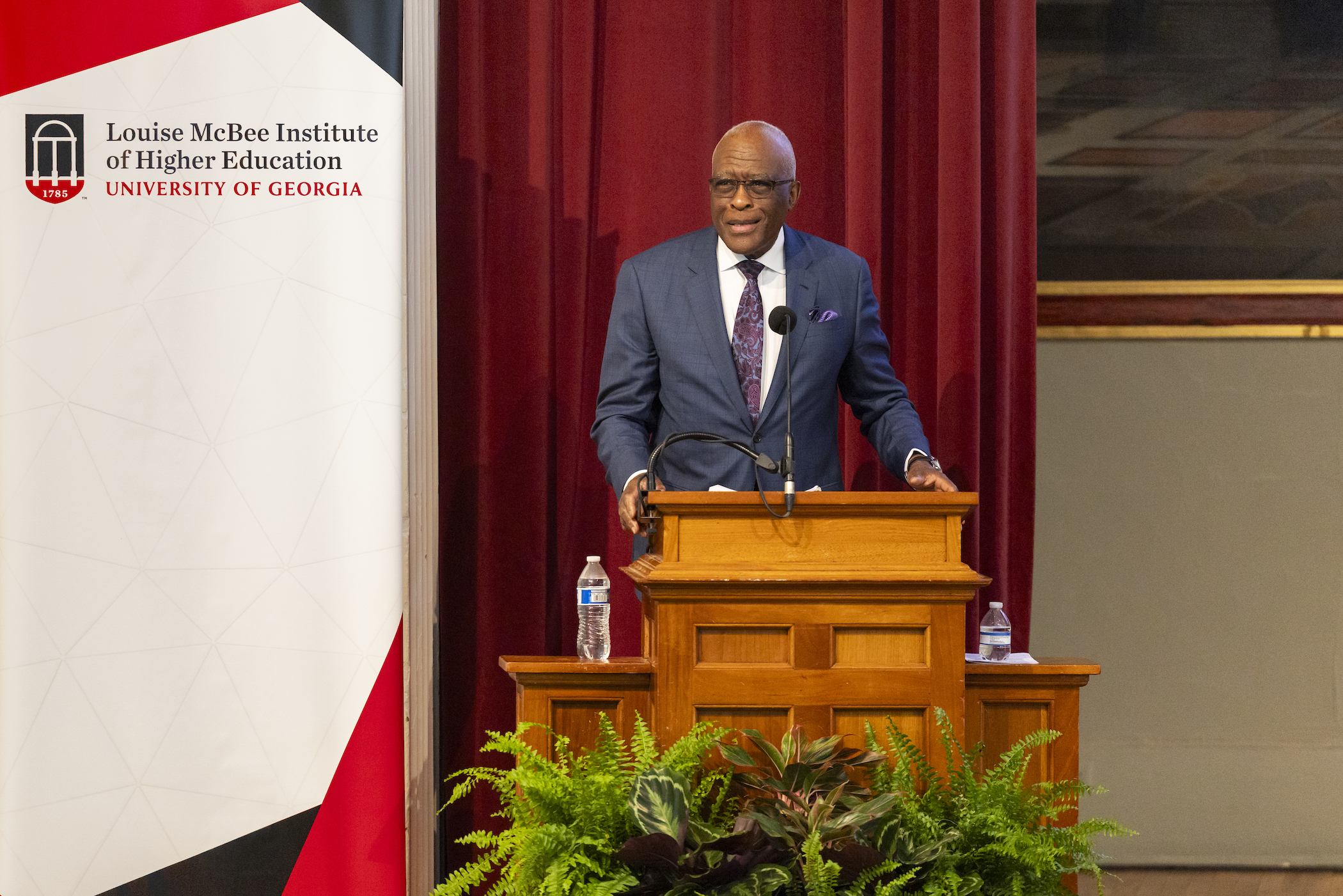
And he does just that, including at the University of Georgia, where his ties remain strong. He delivered the Mary Frances Early Lecture in 2022, and in April, he gave the Louise McBee Lecture in Higher Education.
The bully pulpit Jones stepped up to decades ago remains one of his most cherished tools. He continues to put in the work, lead by example, and be the best community member—university or otherwise—he can be.