


Imagine you’re a homeowner in Augusta. Your yard was once filled with beautiful trees, but after Hurricane Helene swept through in September 2024, it was reduced to a disaster zone. The now-bare landscape transports you back to that frightening time every time you look out the window.
That was the scenario a team of undergraduate University of Georgia students in the New Media Institute certificate program imagined when they began developing an augmented reality web-based application for the Grow Back Project, a multidisciplinary collaboration between UGA and the Community Foundation for the Central Savannah River Area.
“It’s one thing to understand how things work and build something for a class with a rubric, but it’s totally different when this is for real people to use,” said Tyler Nevin, a computer science major and co-developer of the project. “There are more challenges when it’s the real world, but it’s also more rewarding.”
In the summer of 2025, the Community Foundation for the CSRA turned to UGA for help developing a long-term recovery tool to support residents in replanting and restoring the tree canopy lost in the wake of Helene’s destruction. The Grow Back Project, supported by Georgia Power, emerged as a practical, future-forward solution to reforest the Greater Augusta region by empowering the community with information and resources.
The core of the project is a custom interactive website where residents can identify the best trees to replant, enhancing their property while improving resilience to future storms. The website, launching in fall 2026 at the two-year anniversary of Helene, will feature a robust database of trees selected by horticultural and forestry experts at UGA, planting and care guidance, and connections to community reforestation events. By entering their zip code, users will be directed to trees best suited to their area, learn about how to plant and maintain trees, and gain information about community support efforts.

At UGA, the team was built to capitalize on the knowledge at the university to support all aspects of the project, ranging from tree identification to website design. The project includes faculty from Public Service and Outreach units including the Archway Partnership, the State Botanical Garden of Georgia and the Carl Vinson Institute of Government. In addition, faculty and graduate students from the Warnell School of Forestry and Natural Resources and the College of Environment and Design, undergraduate students from majors across campus and Cooperative Extension agents from UGA and Clemson are involved in various aspects of the project.
UGA students were engaged to put their classroom skills to work supporting Georgians as a part of the larger project.
“We were very hopeful that students could play a role in this work, and we’re thrilled with what they’ve done,” said Kerry Bridges, Georgia Power region executive. “The level of collaboration and getting the right people in the room is why it is so terrific to work with UGA.”
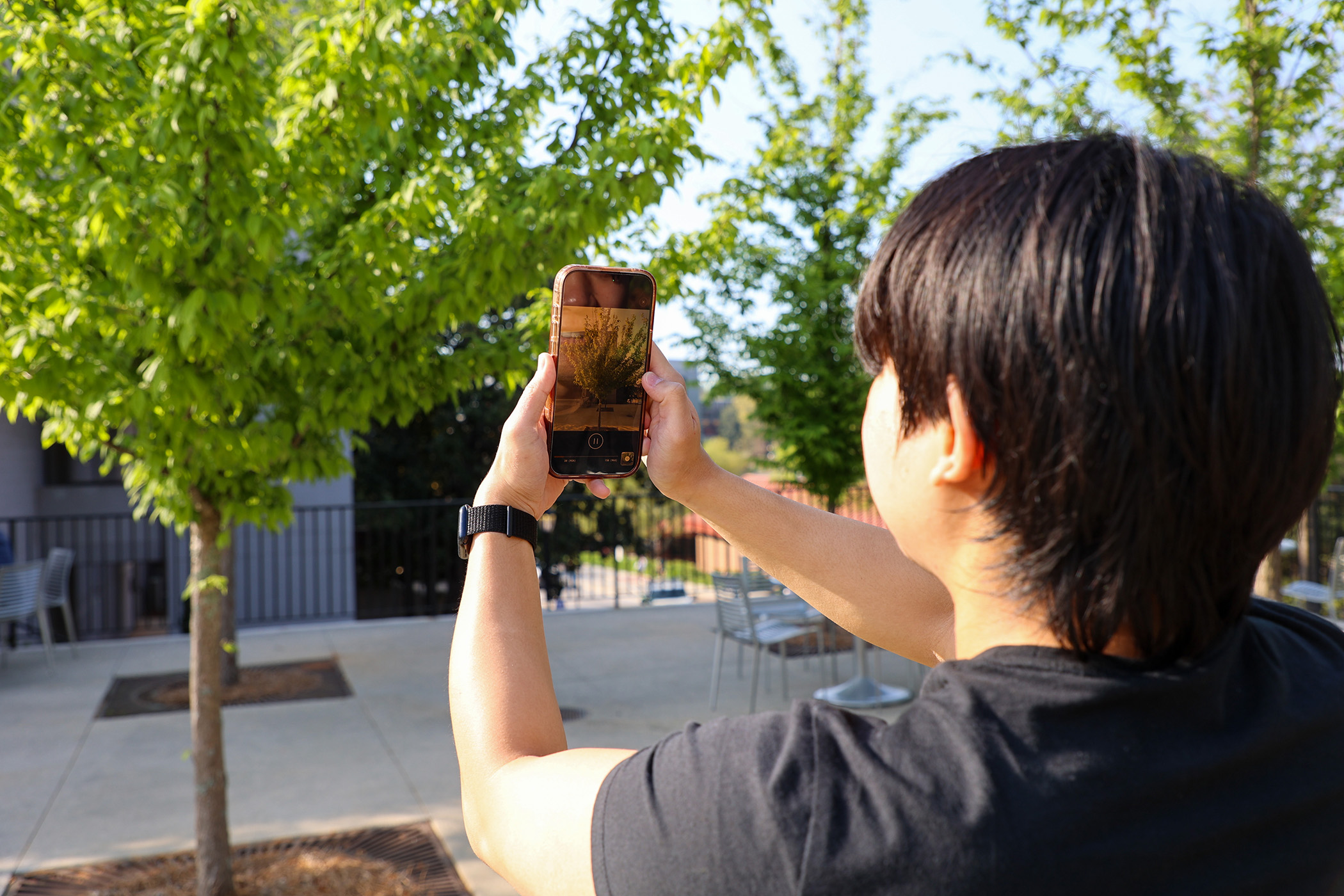
Students in the NMI certificate program used their skills to provide interactive digital solutions for real-world problems. They worked toward three main goals for their portion of the broader project: create a technology tool that could help homeowners visualize trees in their actual yards, be user-friendly for all backgrounds and technology levels, and to be web-based so it can be accessed directly through the website to avoid app fatigue. The team developed an augmented reality tool that allows homeowners to use their phone camera to see their yard and then add virtual trees to the image, moving around with 3D capability to get a sense of the tree in their space.
“I’m excited to be working on a project that shows how this technology can really help people,” said Kevin Huynh, a computer science major and co-developer. “Many people think these kinds of technologies are just for video games, but they can be very useful in many situations. I’m glad to be a part of something that shows that.”
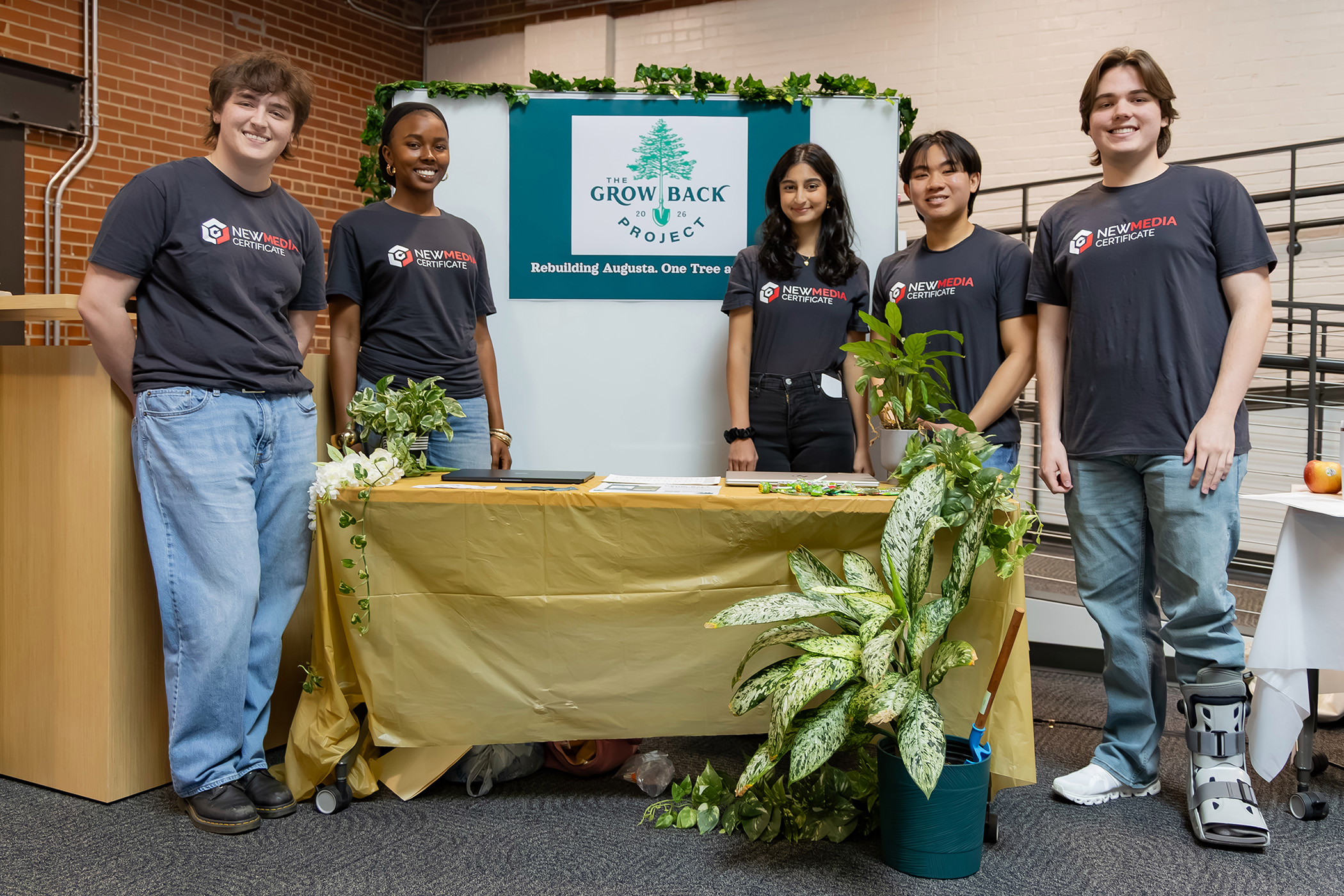
When the team started out, they faced many challenges including how to keep this tool user friendly.
“I felt a sense of responsibility beyond the coursework to have empathy for the user and how they’re going to navigate through it,” said Amaya Powell, a psychology major and co-designer. “People are using this project to rebuild. It was important to make something that connects with them.”
The Grow Back Project is a clear example of how UGA fulfills its land- and sea-grant role to serve the state through its three-part mission of teaching, research and service. The process starts with listening to a community and partnering together for solutions. Students gain experiential learning opportunities by cultivating professional skills including critical thinking and clear communication while applying their classroom knowledge towards a community-identified need.
And the partners are thrilled with the students’ efforts.
“This is a tremendous tool, and people will be so excited to use it, especially knowing UGA students built it just for them,” said Shell Berry, president and CEO, Community Foundation for the CSRA.