

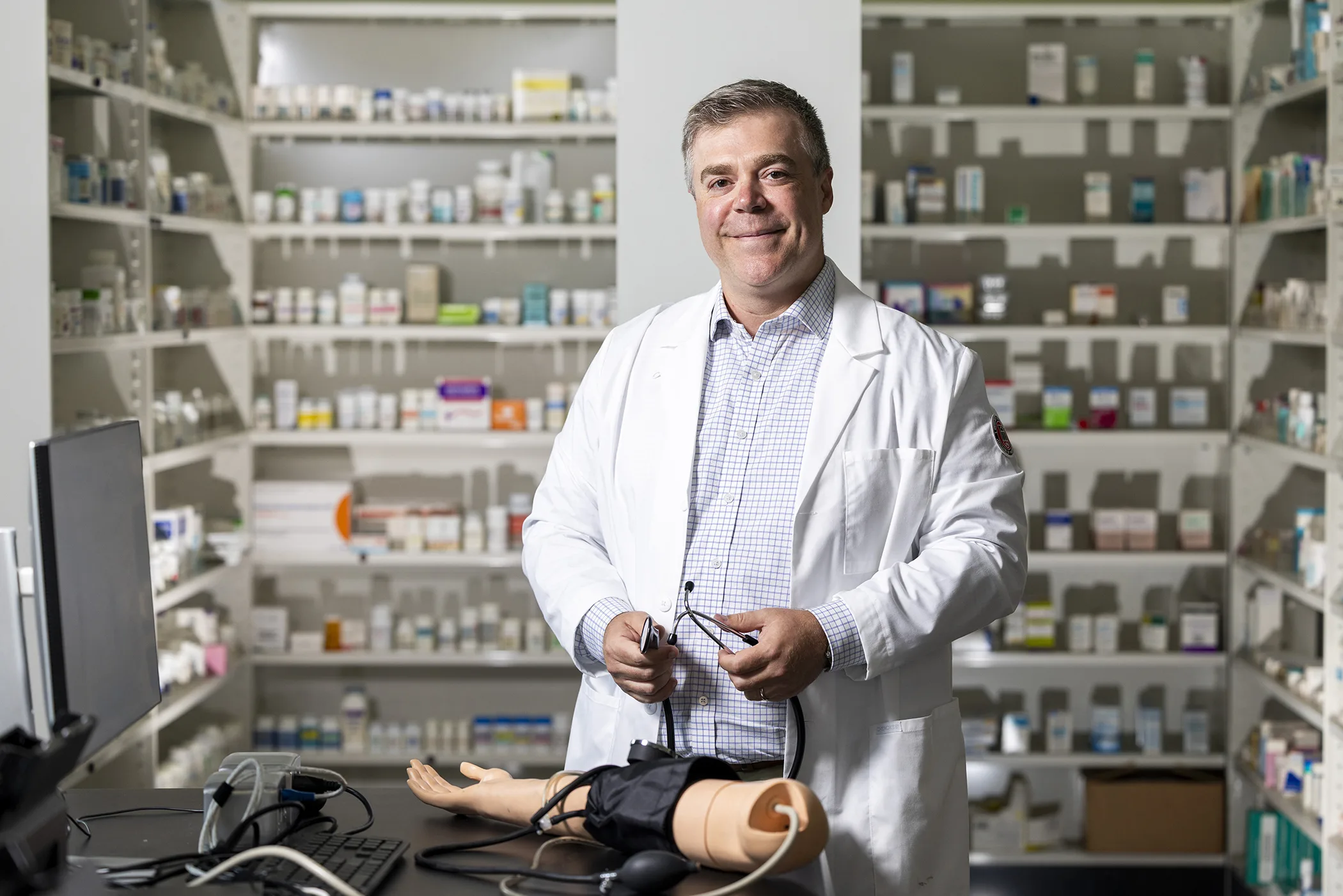
There was a time when Jordan Khail wore a badge to work.
Today, he wears a white coat and his signature smile as he prepares his students to become future pharmacists. The two roles might seem worlds apart, but to Khail, they share something fundamental: an impassioned desire to make a difference.
“I truly believe we can all make a difference in our communities if we simply serve and care for one another. That’s been a common thread throughout my varied career and one that I try to instill in my students every day,” he said.
It is a thread that has carried the University of Georgia College of Pharmacy lecturer on a winding career path — from community pharmacies in Georgia and Colorado to the Georgia Drugs and Narcotics Agency and, ultimately, to pharmacy classrooms and laboratories at UGA.
For students who know him as “Dr. Khail,” it may be hard to imagine him in his former role as a special agent for the Georgia Drugs and Narcotics Agency, or GDNA. Khail spent several years with the agency, where he managed regulatory compliance for more than 400 board-registered facilities in metro Atlanta.
Eventually, though, Khail found himself drawn to education and back to UGA, where he earned a bachelor’s degree in biology in 2007. He joined the College of Pharmacy in 2021 and now teaches courses in addiction and substance use disorder, pharmacy law, compounding and community pharmacy practice.
The impact of his experience is evident in the classroom. His students learn pharmacy law from someone who has enforced it. They learn about substance use disorder from someone who has devoted years to understanding addiction, particularly the opioid epidemic. And they learn about community pharmacy from someone who spent years working behind the counter.
Perhaps that is why Khail has become a fan favorite among students. He doesn’t just teach them what pharmacists do. He shows them why it matters.
Taking the cause to rural Georgia
Khail’s philosophy extends well beyond the classroom. He is the principal investigator on a $1.2 million Georgia Opioid Crisis Abatement Trust grant designed to expand access to opioid harm-reduction services in rural areas of the state. The two-year initiative partners with rural community pharmacists to establish hubs where patients can receive naloxone, education and connections to local treatment and recovery resources. To date, more than 20 rural pharmacies have joined the project, with plans for expansion to 60 locations across Georgia.
For Khail, the project is about recognizing something that rural pharmacists have long understood: Sometimes the most important healthcare resource in a community is the person behind the counter at the local pharmacy.
“By equipping community pharmacists with tools to offer lifesaving interventions, this project aims to reduce the stigma surrounding addiction and connect individuals to the resources they need,” Khail said. “It is helping individuals navigate their path to recovery, which ultimately saves lives.”
The pharmacist becomes the patient
Much of Khail’s career has been spent helping others navigate some of the most difficult moments of their lives. Then, the teacher and pharmacist became the patient.
A diagnosis of testicular cancer almost two years ago gave him a perspective no classroom, pharmacy or law enforcement position could provide.
The experience changed the way Khail thinks about health, patients and the precious commodity of time. It also turned him into an outspoken advocate for early detection, which he credits with contributing to his full recovery, and the value of a robust support system for those receiving treatment.
His personal testimony is simple but powerful: Sometimes the most important intervention is the one that happens early.
The professor behind the white coat
The experience also gave Khail another opportunity to practice what he teaches his students every day — the power of resilience and advocacy, the value of relationships and the simple but profound concept that healthcare is ultimately about people.
Khail’s students recognize that humanity in their teacher every day. On numerous occasions, they have selected him to serve as a faculty pinner at the annual Pinning Ceremony for the college and as a faculty hooder at the spring Commencement. Those honors speak volumes about the mentor-mentee relationships Khail is passionate about creating and preserving.
Third-year pharmacy student Bayleigh Miller-Ulrich, who calls Khail her “pharmacy dad,” remarked, “What makes Dr. Khail so deeply loved by the students are the investments he makes in us far beyond the classroom. I know that long after I graduate, I will not just carry the lessons Dr. Khail taught me, but the confidence, purpose and love for this profession that he empowers us with each day.”
Sometimes service comes with a badge. Sometimes it comes with a white coat. For Khail, service happens by standing in a classroom and teaching the next generation of pharmacists that they, too, can make a difference in the lives of those they serve.