


As assistant director of licensing for engineering and physical sciences at UGA’s Innovation Gateway, Boyce Clark spends his days helping faculty bring new ideas to life through patents and commercialization.
“Our mission is to take inventions that professors here at UGA create, take it through the patenting process where appropriate, protect intellectual property and then take it to market,” Clark said.
And Innovation Gateway is good at what it does. While it can take three to five years to actually get a patent locked down, that hasn’t stopped UGA from consistently coming out on top compared to other universities.
This year was the third consecutive year that UGA topped the annual rankings of AUTM, bringing 69 products to market in fiscal year 2024. In the 12 years of the rankings, UGA has never been out of the top five.
“We’re always on the hunt for the next big thing,” Clark said.
Before the College of Engineering was established in 2012, agriculture and life sciences were the main areas of UGA’s R&D. Clark started at UGA in 2022, right as the College of Engineering was really ramping up its R&D. With the upcoming opening of the medical school, Clark expects to see a boost in biomedical engineering inventions at the university.
When Clark is looking at a new product, as he learns about it, he asks two key questions: Is it protectable? Can it be commercialized?
A big part of that is understanding why a product is an improvement.
“I love it, because every day is going to be such a wide variety of inventions,” Clark said. “Every day is like an adventure, to learn about a new technology and then to sit with [the inventors] and problem solve about what need this could fill.”
The process can come with a lot of back-and-forth and tweaking. He tells pretty much every inventor he works with to expect their first application for a patent to get rejected. That’s when the back-and-forth comes in, explaining how the invention is different from others already out in the world or seeing if there are any small changes that can be made to allow the product to fill another gap the inventor might not have even considered.
One product Clark is especially excited about offers a new way to crack pecans — something that hasn’t been improved upon for over a century. But the current method leaves a lot of pecan “meat” crushed, which means farmers can get only half as much money for them. This new technology will revolutionize a stagnant practice and help pecan farmers get a lot more money per pound, according to Clark.
“It’s very likely we are going to get that patent, because there’s nothing else out there in that field,” Clark said.
One of Clark’s favorite parts of the work he does is the “ability to highlight what we’re doing here” at UGA. Clark is helping put products with real impact on the market.
But Clark’s work at Innovation Gateway is just the latest chapter of his career. He holds degrees in geology and sociology and a Ph.D. in environmental geochemistry and spent two decades as an environmental consultant working around the world designing groundwater remediation systems.
In 2016, a home experiment while seeking a way to tame his daughter’s frizzy hair in humid weather led Clark to found Lubricity Labs.
Things really blew up after a local news station did a segment on Clark’s company, as several of the station’s affiliates across the country also broadcasted the segment.
“When I woke up, I had 7,000 orders,” Clark said. “The website had crashed because it had exceeded 100,000 views per minute.”
Lubricity Labs went on to be featured by outlets like Teen Vogue and in one of the most viewed stories on Yahoo Beauty in 2017.
Clark closed the business during the COVID-19 pandemic because of issues with getting ingredients. That’s when he went to work for Louisiana State University at its technology transfer office — essentially its Innovation Gateway.
When Clark came to UGA, it was a perfect storm: his family was looking to get out of Louisiana after a barrage of hurricanes, and UGA is “the premier place” for technology transfer.
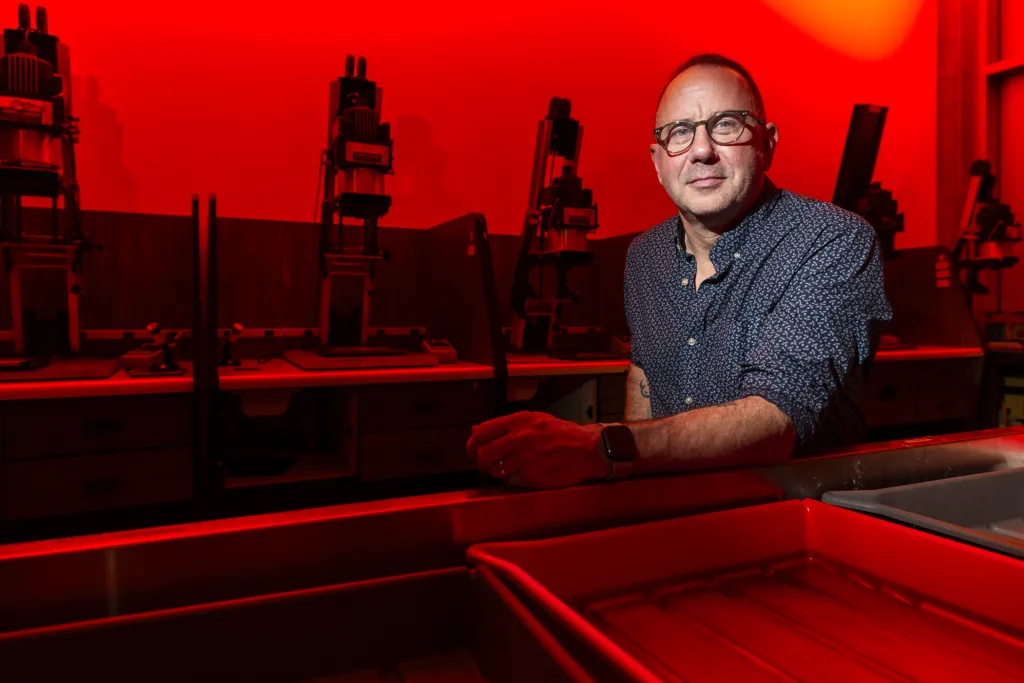
Outside of his work for Innovation Gateway, Clark devotes himself to a different kind of innovation — art that draws directly on his background as a scientist. That’s not surprising if you look at the decorations in his office in Terrell Hall.
“I’ve always moved between science and art,” Clark said. “The way I think as a chemist influences how I create as an artist, and the creativity I bring to art shapes the way I look at scientific problems.”
Clark’s art practice begins with photography, often using both his own images and vintage photographs as raw material. He layers, manipulates and recontextualizes them into larger mixed-media works that explore memory, material and transformation. This category of photography, known as alternative process, is experimental, time and labor intensive, and relies on wet chemical techniques, echoing the methods of a laboratory.
“Unlike modern digital photography, alt process is slow, methodical and forces me to be very purposeful and deliberate. The results are highly variable, which makes each piece truly unique,” Clark said. “Every experiment and every artwork is a chance to explore a question. The mediums are different, but the mindset is the same.”
This year, Clark was invited to present at a meeting of the National Academy of Inventors. The theme was the intersection of art and science — something Clark is intimately familiar with. For him, that intersection is not abstract — it is lived experience. “Both science and art involve curiosity, problem-solving and iteration,” he said. “Scientists can also be artists. Science definitely informs my art.”