


From touch tanks to tidal creeks, the Marine Education Center and Aquarium immerses learners in the science of Georgia’s coast.

At the end of a long road, framed by live oaks and the steady buzz of a maritime forest, sits one of the University of Georgia’s hidden treasures: the Marine Education Center and Aquarium on Skidaway Island. Just 30 minutes from Savannah, it offers visitors sweeping views of the marsh and a sense of wild seclusion.
Part of UGA Marine Extension and Georgia Sea Grant, the center has introduced generations to the wonders of the coast since opening to the public in 1971 as Georgia’s first saltwater aquarium. The center combines hands-on education, immersive fieldwork, and engaging exhibits to spark curiosity and stewardship.
Each year, thousands of K-12 students hike salt marshes, take research cruises aboard the R/V Sea Dawg, and peer into microscopes in on-site labs, while college students, teachers, and visiting scientists deepen impactful conservation and preservation work through internships, workshops, and research partnerships.
“I have not met one person who didn’t remember some field trip they went on as a kid.”
ANNE LINDSAY, ASSOCIATE DIRECTOR OF EDUCATION, MARINE EXTENSION AND GEORGIA SEA GRANT
Science Up Close
Step inside the aquarium, and Georgia’s coast comes alive. Sixteen tanks feature more than 100 native species from seahorses to stingrays while touch tanks invite visitors to feel the shell of a horseshoe crab or observe the slow crawl of a hermit crab. Each display is designed with a purpose: to introduce the incredible diversity of coastal wildlife and connect it to larger themes of conservation and research.

For students of all ages, those encounters spark the kind of curiosity that textbooks can’t deliver. An afternoon exploring exhibits often dovetails with hands-on lessons in the lab or field, turning a look at a lionfish or oyster reef into a deeper conversation about invasive species, ecosystem health, and stewardship of Georgia’s coastline.
Anne Lindsay BS ’87 has spent nearly three decades creating an environment where discovery can happen at any age. She joined the aquarium in 1998 as a marine educator and now serves as associate director of education for Marine Extension and Georgia Sea Grant. She leads a team of educators whose programs are rooted in experiential learning while also aligning with Georgia Department of Education teaching standards, providing students with memorable experiences that connect directly to classroom learning.
“I have not met one person who didn’t remember some field trip they went on as a kid,” Lindsay says. “We’re trying to capture curiosity, excitement, and the willingness to explore the natural world and coastal areas because they’re so very important to our lives. Everybody is a fan of the ocean and the coast, but not everybody has had experiences that make those places personal to them. That’s what we try to do here.”
School groups can go behind the scenes to see how tanks are maintained, meet with marine educators for interpretive hikes on the nature trail, or take part in workshops on barrier islands that turn encounters with habitats and wildlife into broader lessons about ecology, climate, and conservation.
Solving Salty Problems
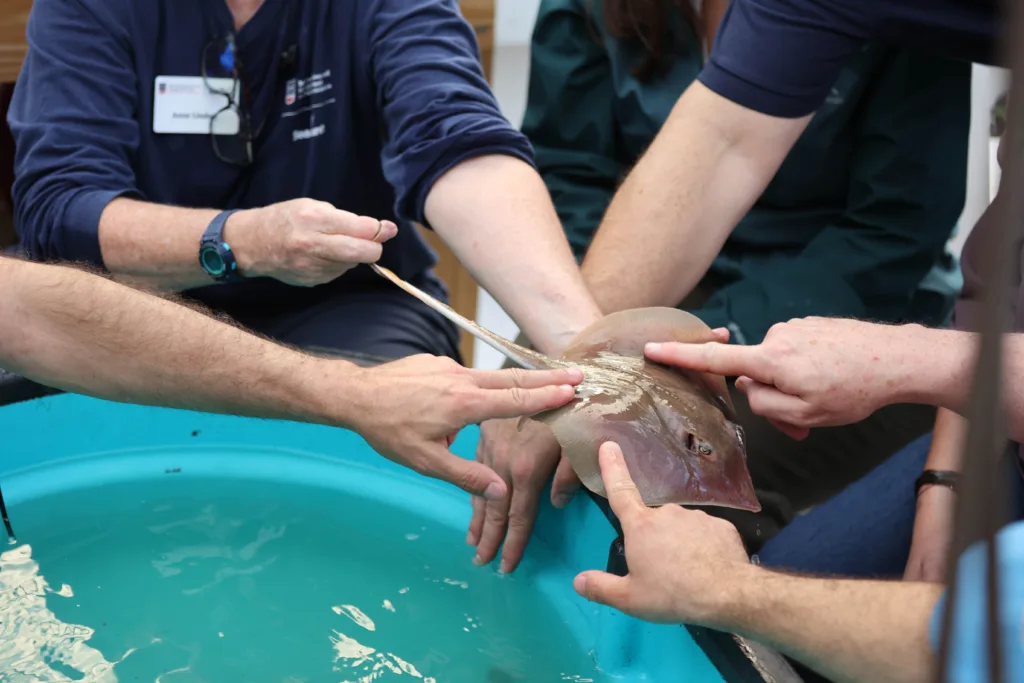
The aquarium draws scientists from across Georgia who use its resources to study marine life and ecosystems. Graduate students, faculty, and partner researchers turn the surrounding waters and lab spaces into sites for discovery, often working alongside volunteers who help extend the reach of the scientists’ work.
For example, Mallory Mintz, a doctoral candidate in the Franklin College of Arts and Sciences’ Department of Marine Sciences, collaborates with the aquarium’s phytoplankton monitoring volunteers, part of a National Oceanic and Atmospheric Administration network, to track blooms of Akashiwo sanguinea, a red tide species linked to harmful algae blooms. The volunteer program running at the aquarium spans more than 20 years and provides a rare long-term dataset while also giving the public a chance to contribute directly to coastal science.
Another focus at the aquarium is communicating science to the public, including research on living shorelines. These natural barriers, built with recycled oyster shells and native plants, protect shorelines from erosion. Unlike seawalls or bulkheads, living shorelines stabilize banks while creating oyster reefs, improving water quality, and providing critical habitat for coastal wildlife.
UGA researchers are part of the Georgia Living Shoreline Workgroup, a coalition of scientists, managers, and conservationists testing these nature-based solutions across the coast. The aquarium’s newest exhibit, a 3D interactive diorama, brings living shorelines to life while sharing information about their benefits to coastal communities.
New Exhibits, More Opportunities
As the number of visitors to the aquarium continues to rise, staff are looking for ways to enhance exhibits and teaching spaces to showcase a broader variety of coastal wildlife to more people. Popular ambassador animals like gopher tortoises, diamondback terrapins, and non-venomous snakes are currently housed behind the scenes, limiting the aquarium’s ability to fully showcase the diversity of Georgia’s coastal and upland habitats.
“Sometimes, for some people, it takes learning a little bit more about an animal and its behaviors to really gain an appreciation for it or to become more comfortable with animals like snakes or alligators.”
LISA KOVALANCHIK, AQUARIUM CURATOR

“Having space for larger habitats that are more tailored to the well-being of our ambassador animals but that also evoke the natural behaviors of these animals gives people a glimpse into their lives,” says aquarium curator Lisa Kovalanchik MS ’22. “Sometimes, for some people, it takes learning a little bit more about an animal and its behaviors to really gain an appreciation for it or to become more comfortable with animals like snakes or alligators.”
New interactive exhibits will introduce visitors to the maritime forest ecosystem, with plans for a freshwater wetland exhibit, a multi-sensory 3D live oak tree, and a kid-friendly forest floor crawl.
New research-focused exhibits will provide opportunities for discovery while improved teaching spaces will allow educators to accommodate more school groups and visitors. With design concepts in place and fundraising underway, the aquarium aims to better reflect the richness of Georgia’s coast while inspiring the next generation of environmental stewards.