

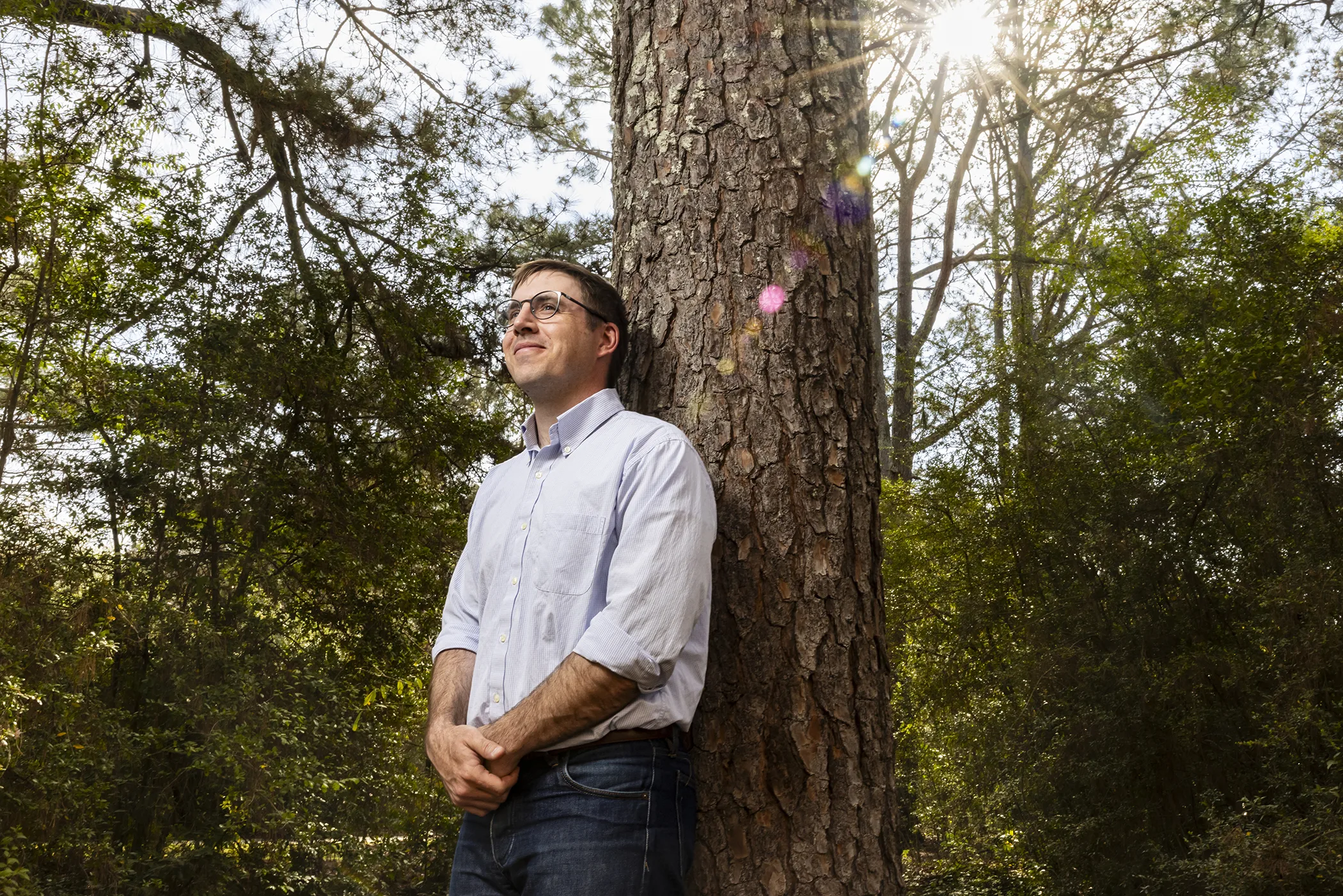
Stephen Kinane signed his job offer from a hospital room, finalizing his return to the University of Georgia just hours before the birth of his daughter.
“At that point, I knew this was going to be a lifestyle career,” said Kinane, assistant professor of silviculture at the Warnell School of Forestry and Natural Resources.
For him, Warnell was already familiar ground, a place that had shaped him as a graduate student years earlier. There, he saw firsthand the dedication faculty brought to mentoring students, the way colleagues collaborated across disciplines and the lasting connection alumni maintained long after graduation.
But his path to forestry began long before he arrived at Warnell.
Growing up, Kinane spent much of his time outdoors as an Eagle Scout, while his father, a forestry graduate from North Carolina State University, built a career as a soil conservationist. Those early experiences made the field feel like a natural fit, but what drew him in was its breadth.
“It’s a very multidisciplinary field,” Kinane said. “You’re trying to understand how a biological system behaves, and you’re using tools from economics, biometrics, chemistry and calculus to measure and model it. That’s what I really like about it.”
After earning his bachelor’s degree from NC State, Kinane came to Warnell for graduate school, completing his master’s and Ph.D. before working as an inventory analyst. He returned in 2023 to join the faculty.
“I wouldn’t have gone just anywhere,” he said, noting he applied to only a handful of academic positions.
He said the sense of investment and support at Warnell, from faculty, alumni and the broader community, was a major factor in his decision to return.
Now, he teaches alongside former mentors, a shift that continues to shape how he approaches his role.
“To think about them as colleagues is special,” he said. “People like Pete Bettinger, a great professor and now an incredible colleague and mentor.”
In 2025, Kinane received the Xi Sigma Pi Outstanding Teacher of the Year award, recognition that matters because of who it comes from — his students.
“If you can connect with students, that’s everything,” Kinane said. “We can make this fun, or we can make it just a job.”
His approach balances challenge with adaptability. He said he isn’t afraid to push students, trusting they can meet high expectations.
“At the end of the day, they’ll be able to do it. You have to put a little pressure on at times. That’s how they learn,” Kinane said.
He also emphasizes meeting students where they are. Forestry education at Warnell blends traditional coursework with hands-on, outdoor experiences.
“We have a very strong classroom component,” Kinane said. “But a lot of people come to Warnell to do things outside. We have the ability to bridge that gap, to have tangible experiences while we’re also doing core lectures.”
For Kinane, that flexibility and presence are essential.
He sees teaching as extending beyond class into extracurriculars, fieldwork and the connections that create a sense of belonging.
“It’s more than just taking classes. It’s a way of life,” Kinane said. “We’re already a small community on a large campus. Let’s stick together and have a good time while we’re trying to get them through the program.”
He brings that same mindset to his research, where the stakes extend far beyond academia.
Kinane studies how forests grow, helping landowners make informed decisions shaped by markets and climate pressures. In forestry, outcomes unfold slowly, making reliable data essential.
“These decisions can take decades to play out,” Kinane said. “We’re trying to give people the best tools possible right now.”
Through his work with the Plantation Management Research Cooperative, Kinane draws on more than 50 years of continuous data to support models that guide those decisions. That depth allows researchers to offer guidance grounded in real-world outcomes.
“For some people, this is their retirement. It’s their livelihood,” he said. “We’re trying to help them stay on the path to success.”
Alongside that data, new technologies, including remote sensing and artificial intelligence, are expanding what researchers can measure. But Kinane said they are not solutions on their own.
“It’s just that — a tool,” he said. “But it can help us make better decisions.”
That long-term mindset carries into other parts of his life, too.
These days, much of his time revolves around his young daughter and family. When he can, he tends a garden of daylilies and irises or works on his truck, a slower, more deliberate pace than before.
“I’m just trying to be a present dad,” Kinane said.
It’s a simple goal, one that mirrors how he approaches his career: steady and intentional.
Kinane has come full circle. And like the forests he studies, he’s thinking long term about what he’s helping grow for the future.
That same sense of investment shapes how he sees Warnell, a place defined not only by its research and reputation, but by the people committed to building something that lasts.
Kinane understood that as a student. Now, as faculty, he is working to add to it.