

The University of Georgia plans to redevelop the Legion Pool and Legion Field area to better serve and support its students. The decision comes upon the recommendation of a working group that has considered the highest and best use of this space, located in the heart of the Athens campus, for the last six months.
“Our in-depth study demonstrated that fewer than 2.5 percent of our students use Legion Pool, which is only open from late May to early August, yet its operation is predominantly supported by the Student Activity Fee,” said Dean of Students Eric Atkinson, who chaired the working group. “In addition, the pool loses an estimated 24,000 gallons of water a day through leaks and evaporation and loses nearly $90,000 per year, with this operating deficit covered by Student Activity Fee reserves. For all these reasons—usage, sustainability and cost of maintenance and operation—our working group concluded that an alternative use provided the best option for our students.”
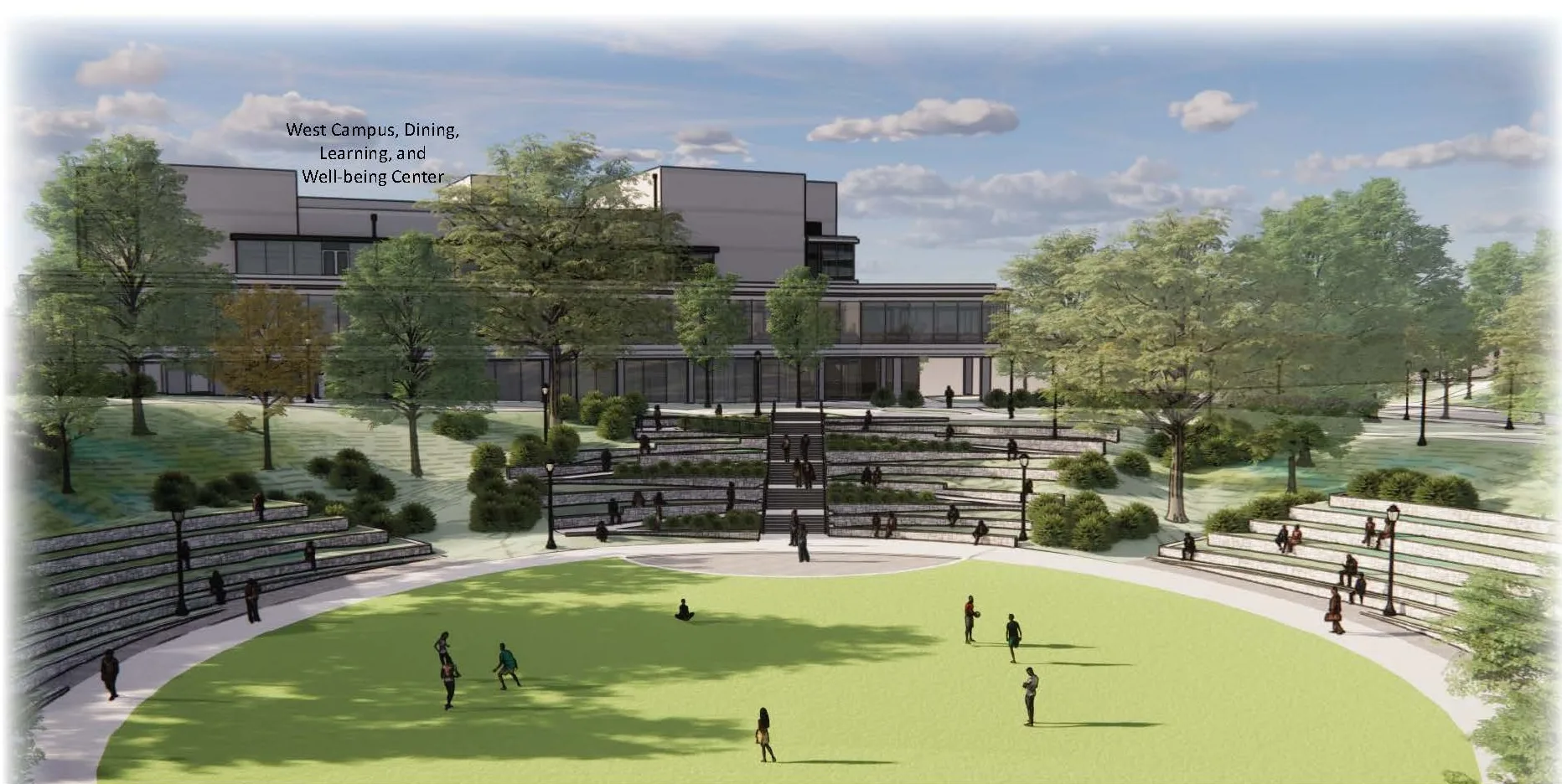
That alternative is to remove Legion Pool, its pool house and the Legion Field concert stand, while Legion Field will be enhanced to create an expanded community green space and an outdoor amphitheater using the site’s natural topography. The project also will create 70 additional parking spaces—a critical need in a busy area of campus where thousands of students live and eat in residence and dining halls, take classes at the Miller Learning Center and the Business Learning Community, and enjoy the amenities of the Tate Student Center.
The redesigned Legion Field area is planned for completion in Fall 2026, complementing the opening of the adjacent West Campus Dining, Learning, and Well-being Center.
“It is incredibly exciting to see this vital area of campus redeveloped to better support our student body,” said Vice President for Student Affairs Michelle Cook. “By creating a beautiful green space and gathering area, as well as an expanded venue for events and concerts, this reimagined site will foster enhanced well-being and connection among our students while providing a unique asset for our more than 850 student organizations.”
In reaching its recommendation, the working group analyzed Legion Pool and Legion Field usage reports, financial records, and a Counsilman-Hunsaker swimming pool audit, as well as a Legion Field planning study and a historical resource study. Members—which included several student leaders as well as the university architect, associate vice president for student well-being, and associate vice president for public safety, among others—also toured the site, conducted a benchmarking analysis, and solicited input from student leaders and campus units impacted in the area. The group’s final report was submitted on August 1.
In recent years, despite rising enrollment and the need for additional community green spaces on campus, Legion Field and Legion Pool have been increasingly underutilized. In its current form, Legion Field is unused approximately 92 percent of the time, hosting just 26 scheduled events per year. Meanwhile, Legion Pool has experienced a significant decline in visits and revenue in recent years. Annual visits to Legion Pool have dropped more than 30 percent since 2019, with approximately half of the visits coming from UGA summer camps and about 20 percent from the local community.
Beginning next season, UGA summer camps will have the option to relocate their swimming activities to the three indoor pools at Gabrielson Natatorium in the Ramsey Student Center. Meanwhile, UGA faculty and staff can continue to purchase passes to the Ramsey Student Center for themselves and their families, as they have in the past.
“Many of our students live off-campus in apartment complexes that feature swimming pools, and Athens-Clarke County also offers several outdoor pools for community use,” said Gwynne Darden, associate vice president and university architect. “A compelling factor to those of us charged with stewardship of University resources is the massive amount of water being wasted each day.”
Over the last five years, Legion Pool’s total net revenue losses have amounted to $438,645, with the pool realizing a net loss of almost $90,000 in Fiscal Year 2025 alone. When the Legion Field site is redeveloped, Student Activity Fee reserves previously used to offset these annual deficits will be redirected to support initiatives that directly benefit students, such as the UGA Food Pantry, among other programs.
“Legion Pool is open during the summer months but closes by the time most students come back to campus,” said Student Government Association President John Neely, who served on the working group. “The Student Activity Fee is meant to support the student body, and this redevelopment plan will do exactly that. This beautiful green space will act as the ‘backyard’ of several first-year residence halls, offering a place for students to socialize, study, and relax on campus.”
“Most students are not aware of Legion Pool and Legion Field, so they don’t take advantage of this part of campus,” said Rock Rogers, immediate past president of the Student Government Association and now a first-year UGA law student, who also served on the working group. “I am excited to see this redevelopment transform a rarely used area into a place that better serves students, brings them together, and helps them make friendships and wonderful memories.”
A historic resource study commissioned by UGA’s Office of University Architects for Facilities Planning recommends that Legion Pool, its pool house and Legion Field qualify for eligibility on the National Register of Historic Places. Because of this possibility, the University will follow appropriate procedures required by the State Historic Preservation Office, the Georgia Environmental Policy Act, and the University System of Georgia. The reenvisioned area will retain the name, Legion Field.
“As the working group report noted, our students simply haven’t been using Legion Pool for a number of years, and the condition assessment indicates that it would be very costly to bring the pool up to current industry standards,” noted Ryan Nesbit, vice president for finance and administration. “Revitalization of this central area as a communal greenspace and for much-needed parking offers long-term uses that will be heavily utilized by our students.”
The report of the Working Group on the Future of Legion Pool/Legion Field can be found here.