

UGA provides update on Legion Field redevelopment proposal
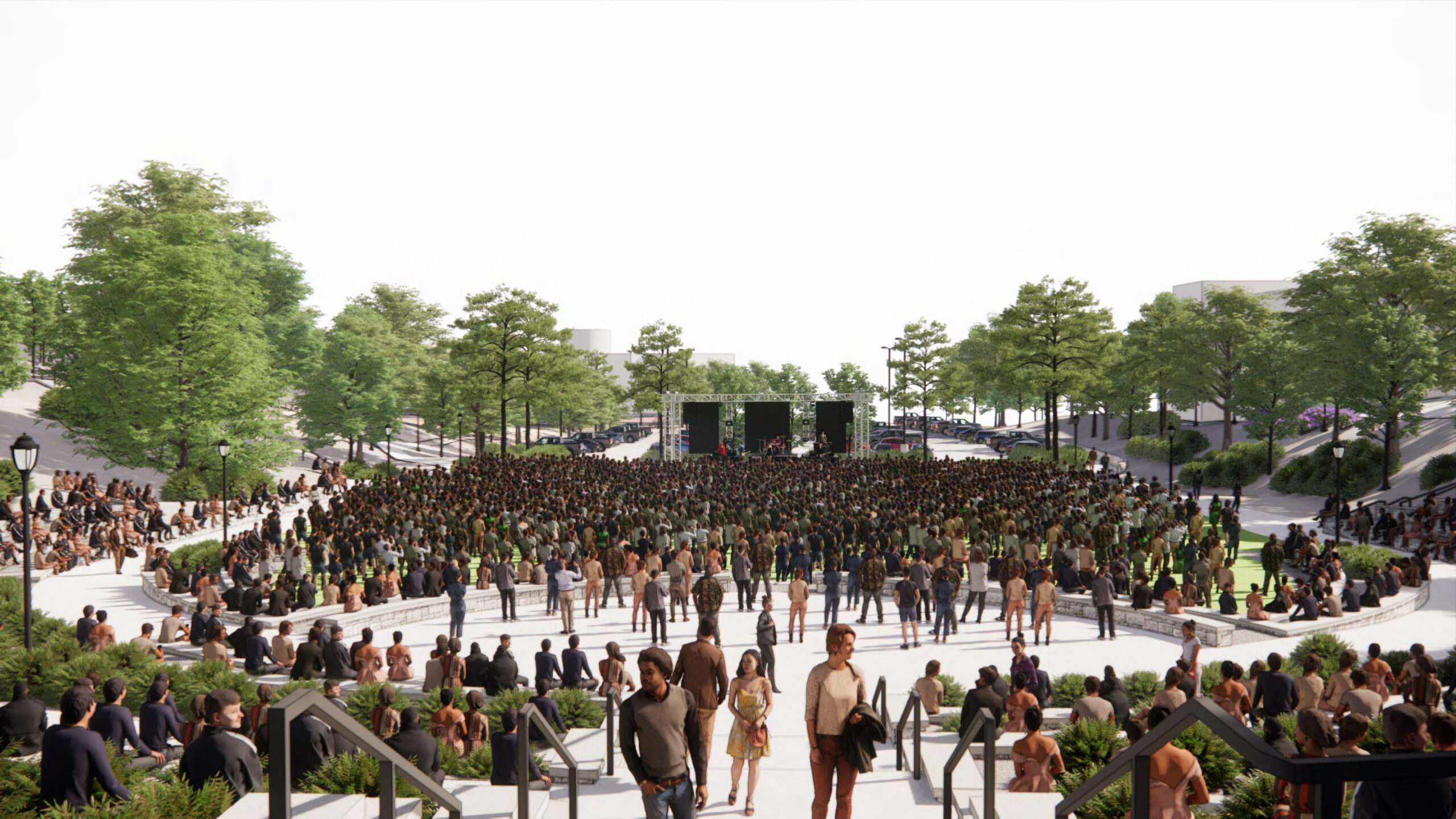
The University of Georgia has completed the public comment period for the proposed redevelopment of Legion Pool, a project aimed at expanding and enhancing Legion Field to better serve the university’s growing student population.
In September, the university announced a proposal to expand the Legion Field green space by removing the aging Legion Pool facility and transforming the area into an expanded green space and amphitheater, roughly doubling the size of the usable field and incorporating the natural slope of the landscape. Initial design studies include terraced and hillside seating for up to 1,100 people, along with standing capacity for several thousand more. The proposal reflects the findings of a campus working group that spent six months assessing the site’s condition, usage patterns and long-term potential with an emphasis on student needs and broader campus priorities.
As required under the Georgia Environmental Policy Act, UGA published an environmental effects report on the project and made it available for public review for a 30-day period ending on Dec. 5. UGA also accepted written public comments on the project during that time. Before receiving the minimum required requests for a public hearing under GEPA, UGA announced on Nov. 19 that it would hold a public hearing on the project to allow an opportunity for more public input. All feedback submitted through these processes will be reviewed before a final decision is made.
UGA held the public hearing from 5:30 to 7:30 p.m., a time selected after reviewing exam schedules in order to maximize opportunities for student participation during final exams. The hearing, which included a total of 34 speakers, followed a moderated format, a two-minute speaking limit, an open sign-up process and was recorded for the public record.
UGA received a number of written comments from Athens-Clarke County residents, alumni, faculty, staff, students and community stakeholders. Overall, a total of 127 comments were received: 84 opposed, 34 in favor, and 9 other comments. More than half of the speakers at the hearing also sent a letter. All written comments will be weighed equally alongside comments shared at the public hearing, in accordance with GEPA.
Many submissions in favor of the project highlighted the benefits the proposed redevelopment offers students and the broader campus community.
Student leaders representing thousands of UGA students in the Student Government Association, Residence Hall Association, Interfraternity Council, Panhellenic Council and University Union, among other organizations, expressed strong support for the redevelopment project.
“Right now, Legion Pool requires over $90,000 in student activity fee funding each year, yet fewer than 2.5% of students use it. That doesn’t feel like a fair or effective investment for the student body,” stated an SGA leader. “The redevelopment plan creates a space that students will actually use. UGA’s announcement highlights new outdoor recreation lawns, more green space and flexible areas for student programs and gatherings. This is a much better fit for how students spend their time on campus today and would bring real value to a far larger group of students.”
Additional student comments conveyed appreciation for expanded outdoor study and recreation spaces near residence halls, enhanced Wi-Fi-enabled seating areas and improved opportunities for student events throughout the year.
UGA also received supportive feedback from faculty and alumni. In a detailed written submission, an emerita faculty member in employment law and legal studies expressed support for the project and noted the pool’s extensive repair needs, historically low student usage and long-term subsidization, as well as correcting misinformation surrounding the pool’s historical connection to desegregation.
“I found myself beyond dismayed, more like totally taken aback and upset, that the argument was ever even presented by advocates of keeping the pool open that it had historical racial integration significance that meant it should remain open despite the fact that few Blacks use it… To keep this little-used pool in need of significant upgrades and repairs open using University funds to subsidize it for a few people, and when other pools are readily available, makes no sense… Be honest. For a few folks it is just a convenient venue that may hold personal history for them, but UGA’s proposed usage that is for all should not be sacrificed for this.”
The university also received letters and oral comments from those in opposition to the project, many of which followed a template and restated similar points regarding the pool’s history and their sentimental connection to it.
“My father was a faculty member, and our summers were spent at Legion Pool. Without it, there would not have been a pool available to many faculty children.”
“For many of us, summer months at Legion Pool are a vital part of our connection to the University. It is a space defined by respect, warmth and genuine care — among patrons and pool staff alike — qualities that are increasingly rare and deeply valued.”
The university will review the full record of oral and written comments before reaching a final determination. Once a decision is made, UGA will publish the required GEPA notice in the Athens Banner-Herald within the timeframe established by state law.
Summary of project background
The University of Georgia convened a working group in early 2025 to evaluate the future of Legion Pool and Legion Field with a focus on student needs and campus priorities.
In assessing Legion Pool, the group reviewed usage and financial data, a professional pool audit, planning and historic resource studies, and conducted site visits and benchmarking analyses over a period of six months. Input was gathered from student leaders and campus units with the key findings of the working group, which included:
- Pool usage is down 55% since 1998 and over 30% since 2019. Students comprise the pool’s smallest user group and represent only 10% of its visitors — fewer than 2.5% of the student body in recent years.
- Legion Pool has incurred operating deficits for 24 consecutive years. It has lost $438,000 over the past five years, including $90,000 last year alone. This deficit has been borne by UGA students through coverage by the Student Activities Fee.
- From an environmental standpoint, the pool is estimated to lose 24,000 gallons of water per day during the summer operating season.
- Recent utilities data shows that when the use of the bathhouse and associated facilities is factored in, water use is considerably more.
- An average of over 39,000 (39,175) gallons of water was used per day between this past June 24th and July 16th as compared to 326 gallons per day between this past Aug. 15th and Sept. 9th.
- Estimates for basic repairs to the pool range from $926,000 to $2.175 million, plus the costs for additional repairs under the pool.
- Replacement of the pool alone would cost an estimated $5.7 million while a comprehensive replacement of the entire facility would cost an estimated $11.4 million.
- Athens-Clarke County offers five community pools and two splash pads, ensuring community-wide access. This includes the recently reopened Bishop Park pool, refurbished with $7.5 million in SPLOST-funded improvements. These facilities provide accessible recreational options for the local community.
Based on the findings related to student usage, financial and environmental sustainability, capital investment needs and redevelopment potential, the working group concluded that continuing operations under any administrative structure would remain financially unsustainable and recommended redeveloping the site to better serve UGA’s growing student population.
The proposed redevelopment will expand Legion Field into an open community green space and amphitheater that takes advantage of the site’s natural topography, enhancing year-round access to recreational, co-curricular and community spaces while improving financial and operational sustainability. By removing Legion Pool and its bathhouse, the project will double the usable green space and create a versatile venue for concerts, programs and other events. The enhanced area will include Wi-Fi access to support studying and outdoor classroom activities, and the removal of the pool will also allow for the addition of 70 student parking spaces — representing 20% of the overall project area — to help meet critical demand near residence halls and key campus facilities in the heart of campus.