


Like many others in his industry, Matthew Schmidt didn’t originally set out to become an instructional designer.
“This is a field that we kind of jokingly refer to as the best career that you’ve never heard of,” said Schmidt, a professor in the learning, design, and technology program in the Mary Frances Early College of Education’s department of workforce education and instructional technology.
“I’ve never met someone who says, ‘Gosh, I knew from a very young age that when I grew up, I wanted to be an instructional designer.’ It’s one of those fields where people fall into it from other areas,” he said.
Before joining the University of Georgia in 2023, Schmidt held tenured positions at the University of Florida and the University of Cincinnati. He is affiliated with the Institute for Artificial Intelligence and directs the Participatory, Interdisciplinary eXperience, and Learning Lab.
Prior to studying educational technology at the doctoral level, Schmidt earned undergraduate and master’s degrees in German language and literature. He created language immersion tools using virtual reality before transitioning to the educational technology space, beginning with developing tools for autistic individuals.
“We decided to take a similar approach working with youth on the autism spectrum so that they would be able to practice social skills with many of the same benefits from the technology,” Schmidt said.
That experience broadened to creating technologies for a variety of populations who experience executive dysfunction, including individuals with ADHD, dyslexia, epilepsy, traumatic brain injuries and Type 1 diabetes. These technologies include Virtuoso, a VR tool that aids autistic adults in navigating public transportation systems; Gaming 4 Good, which utilizes the Nintendo Switch console and Game Builder Garage software to engage middle school-aged neurodiverse learners in video game design; and Epilepsy Journey 2.0, the next iteration of a pilot project designed to help individuals with TBIs remember to take their medications.
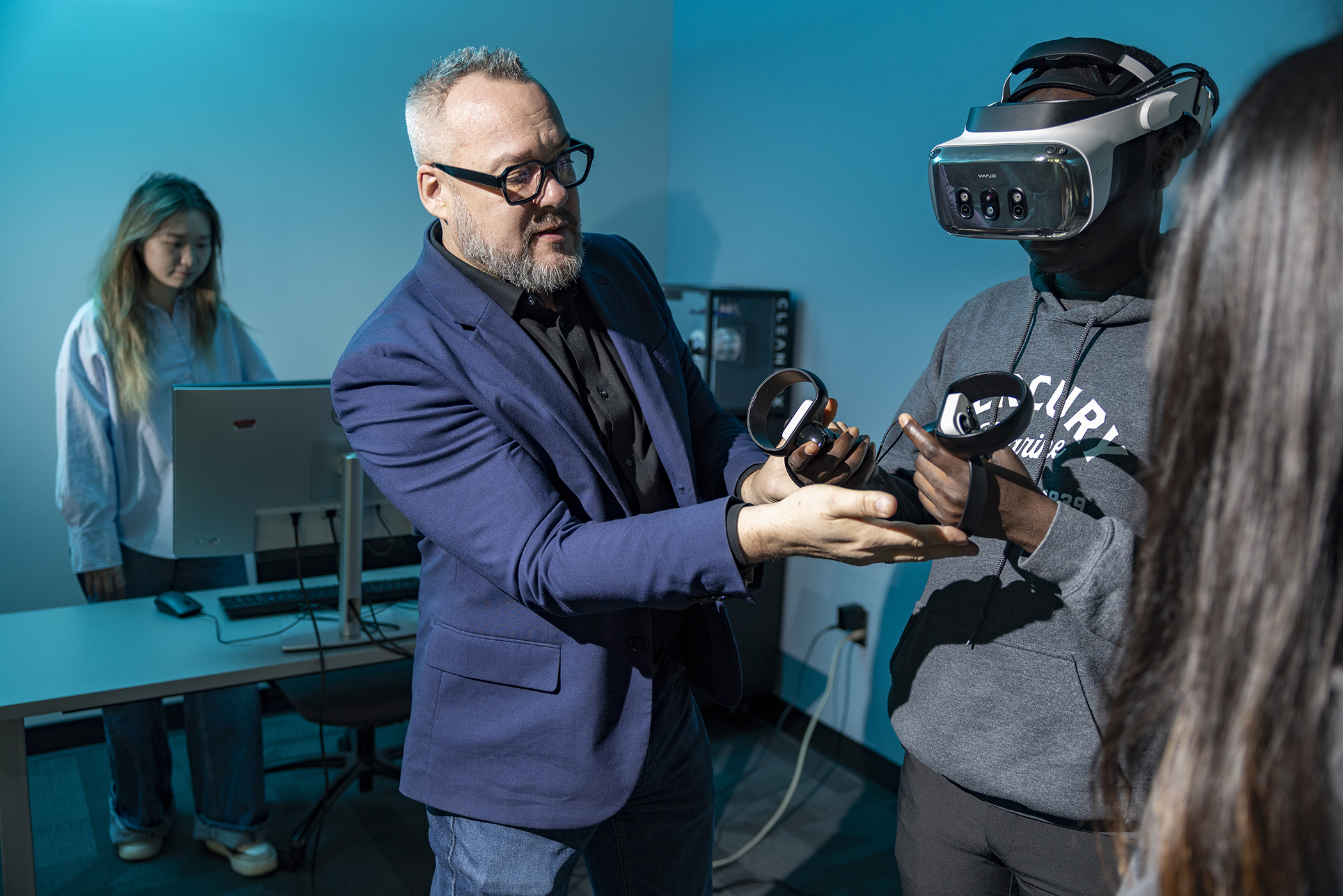
Inclusivity is at the core of Schmidt’s work; most recently, he received the 2026 Jenny Penney Oliver Inclusion and Belonging Award from the College of Education. He emphasizes the importance of the participatory co-design approach: designing with, not for, the populations the interventions serve, as well as their support networks including caregivers, families, educators and health care providers.
Projects utilizing this approach include Epilepsy Journey, which was co-designed with adolescents with epilepsy, and Electronic Problem Solving Training, a digital tool that provides strategies to overcome issues related to having a TBI that was designed with the TBI community.
Schmidt is a practitioner of learning experience design, a philosophy of learning design that borrows from user experience and incorporates social and cultural factors into the design process. In the PIXL Lab, his students learn how to both design instructional technologies and to involve the users of those tools in the design process from the beginning.
“Many of my students do not have a background in disability, so it is through their graduate assistantships and their work in the PIXL Lab that they can gain hands-on experience in working with these populations and in applying learning experience design-based methods or empathy-based methods. They can really put themselves in those shoes of the people they’re designing for and work directly with these impacted populations,” Schmidt said.
For Schmidt, meaningful innovation in educational technology begins by recognizing the expertise of the communities those technologies are meant to serve.
“We’re not designing for, we’re designing with,” he said.