

Nick Foukal’s fascination with the ocean began decades ago, on the waters off the coast of Nahant, Massachusetts, a 3,000-resident beach town 13 miles north of Boston. He remembers spending summers taking the family’s rowboat out with his brother, fishing and setting lobster traps.
But beyond catching crustaceans, Foukal was never particularly interested in the biological side of oceanography. It was physics that caught the attention of Foukal, who is now a physical oceanographer at the University of Georgia’s Skidaway Institute of Oceanography and an assistant professor in the Department of Marine Sciences in UGA’s Franklin College of Arts and Sciences.
While enrolled as an engineering major and a member of the rowing team at Dartmouth College in the late 2000s, Foukal took a course that included a section on the ocean’s physical conditions and processes.
“Bells were going off in my head — ‘this is so cool,’” said Foukal. “Combining my interest and background with the ocean with quantitative, physical understanding of systems, I thought, ‘oh, there’s a whole other side of oceanography and marine science that is not biological, it is about physics and fluid dynamics. That’s what I want to do.’”
The course sparked an interest that set him on the path to where he is today — investigating the resilience of the Atlantic Meridional Overturning Circulation (AMOC), the system of currents that shapes Earth’s climate. Foukal regularly publishes papers in leading journals, and his work is often featured in prominent news publications, including The New York Times and The Washington Post.
The AMOC, known as the Atlantic’s “great conveyor belt,” carries warm, salty water from the tropics north into the Arctic, where the water cools, sinks and returns south. The system’s role in redistributing heat influences temperatures, weather events, ecosystems and even sea level rise. Northern Europe, for example, could experience higher sea levels and much harsher winters if not for the AMOC bringing warm surface water north and releasing heat into the atmosphere.
After graduating with an engineering degree from Dartmouth, Foukal went on to earn his master’s in oceanography from the University of Maine and his Ph.D. in earth and ocean sciences from Duke University, where he studied the AMOC in Susan Lozier’s physical oceanography lab.
“I thought the AMOC was very fascinating, because it has such a huge societal impact,” said Foukal. “Yet, the more I read about it, the more I realized how little we knew about the system. I thought there was a lot of room for growth, and it raises some really societally important questions.”
After graduating from Duke, Foukal spent nearly six years working at the Woods Hole Oceanographic Institution. He started at SkIO in August 2024.
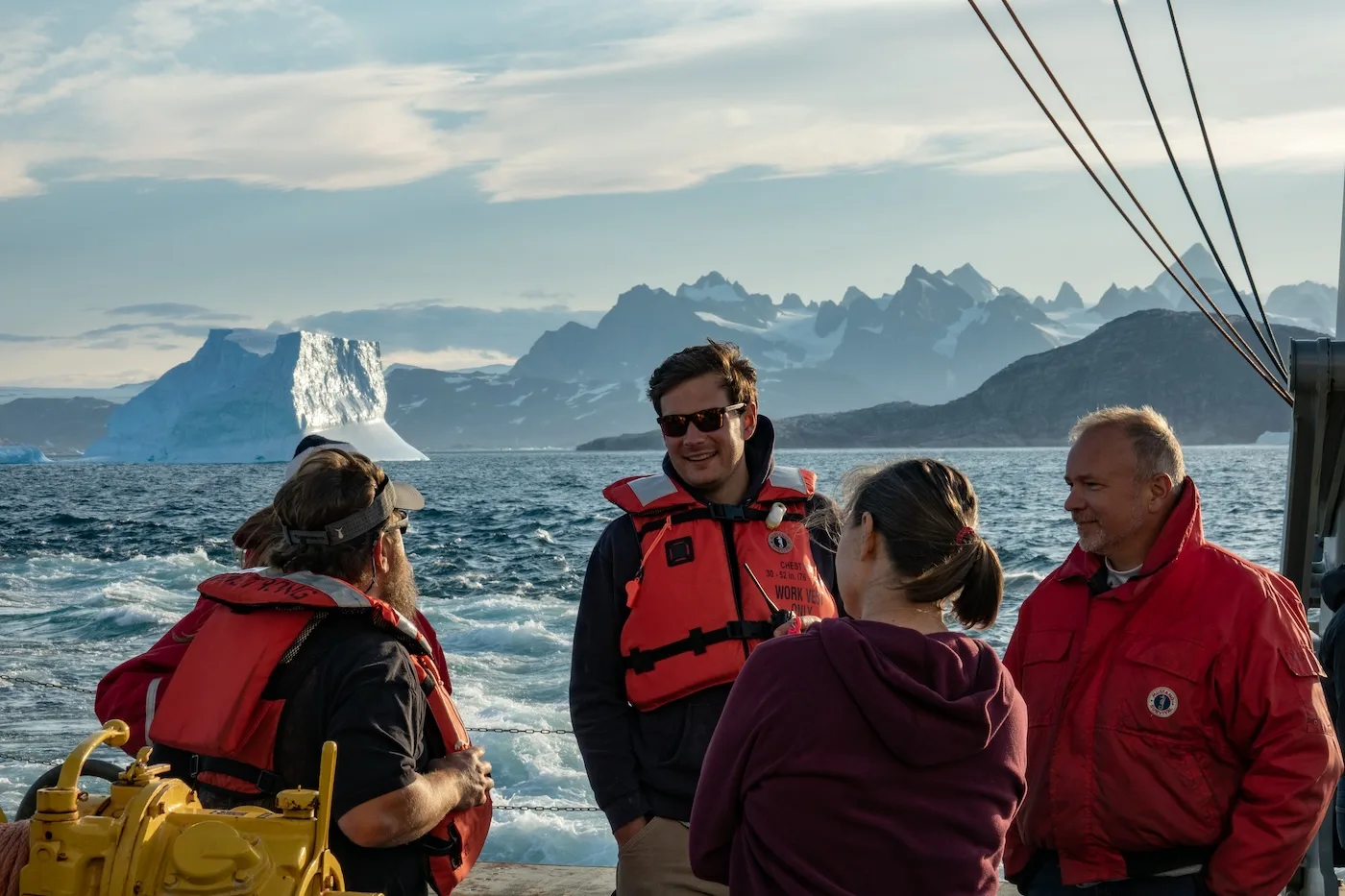
Foukal has traveled across the globe for his research assessing the strength of the AMOC. Currently, he is working on two major projects — one on the Labrador Shelf off the coast of Canada and another on the Northeast Greenland Shelf.
“The general scope of both projects is to better understand where freshwater goes after it enters the ocean — whether from the melting Greenland Ice Sheet or from the Arctic, where melting sea ice and river input add freshwater — and how it could potentially affect the AMOC,” said Foukal. “These are very small geographic areas that we’re studying, but they have a very large impact globally.”
Studying the AMOC is not new to Foukal. Teaching, on the other hand, is. The opportunity to educate undergraduate and graduate students, along with being at an academic institution where education is a central mission, drew Foukal toward UGA and SkIO.
“The first impact of teaching is that I’m passing on education to students, which is fulfilling and rewarding,” said Foukal. “Second is that it really helps my research. I go back to fundamental oceanography. I love being reminded of some of these concepts that we may take for granted in our everyday work.”
The curiosity that began in a rowboat off the coast of a small Massachusetts town now drives Foukal’s research to better understand one of Earth’s most important systems of currents and his commitment to educating the next generation of oceanographers.