

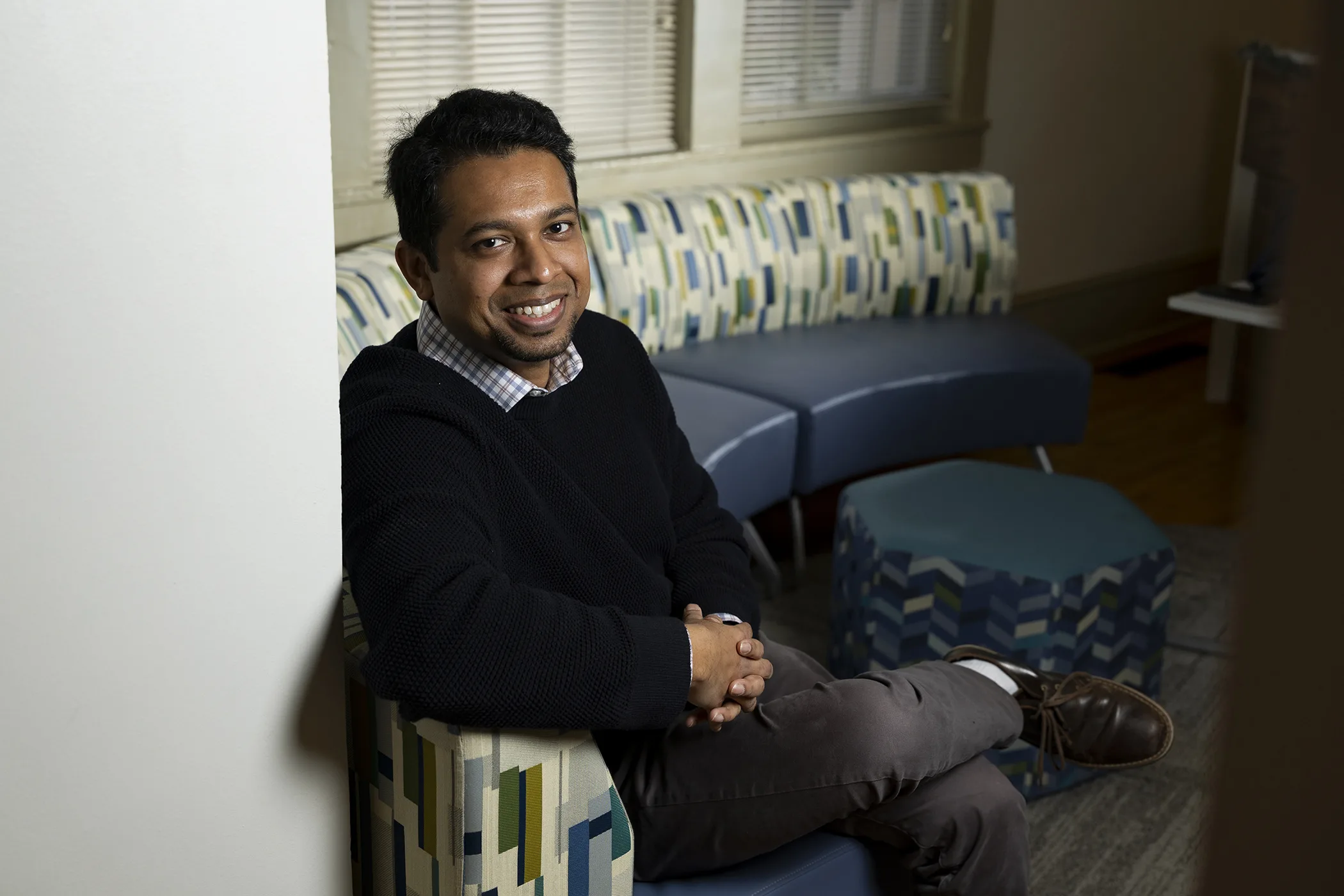
At first glance, Ishtiaque Fazlul’s research portfolio looks like a patchwork quilt: Affordable Care Act coverage, AP test subsidies, effects of long COVID, child marriage policy, maternal health chatbots and predictive models for poverty. But look closer, and a clear pattern emerges. It’s centered on a single guiding question: How do we build systems that help people thrive?
From classrooms in Georgia to health policies across the globe, Fazlul’s work turns questions into solutions to ensure health and well-being for all.
Fazlul is an assistant professor with a dual appointment in the School of Public and International Affairs and the College of Public Health. He describes UGA as a “sweet spot” for his interdisciplinary work.
Fazlul grew up on the Bangladesh Agricultural University campus in Mymensingh, Bangladesh, a college town in the northern part of the country where his father taught fisheries biology and genetics. For college, he moved to the capitol city to attend Dhaka University, where he discovered economics as a lens to understand the world.
“It seemed rigorous and made sense to me,” he said. “I realized I could answer more questions about the world doing economics.”
After graduation, he joined Innovations for Poverty Action, a research and policy nonprofit committed to reducing global poverty. There, he worked on randomized controlled trials to test development interventions. That experience shaped his belief that research can drive change and introduced him to leading economists from around the world who convinced him to further his education in the field.
During graduate school at Georgia State University, his focus shifted to applied microeconomics. Health and education became his passion, leading to studies on the Affordable Care Act and partnerships with school districts to improve equity in K–12 education.
“Education is an important component of well-being,” he said. “If you have education, your income, your health, your overall quality of life improves.”
Today, Fazlul’s projects span U.S. and global contexts but share a goal: to improve health and well-being for all. His education studies show how early learning and AP test access shape long-term outcomes. His international work examines the long-run health consequences of early life social institutions, while his U.S. projects tackle how policies and institutions affect health and opportunity.
Fazlul challenges outdated metrics like free and reduced-price meal eligibility by building predictive models that better identify disadvantages. He applies AI and machine learning to public health, most notably in a maternal health chatbot co-led with communications scholar Soroya McFarlane designed to provide culturally sensitive and accurate guidance for expectant mothers and their partners.
The work, supported by an National Institutes of Health AIM‑AHEAD grant and new proposals in the pipeline, is building toward integration with electronic health records to personalize guidance.
Fazlul brings the same pragmatism to the classroom. In his data analytics for international policy class, he makes statistics accessible to students without prior training.
“We code together in class,” he said. “It’s an accessible way to learn analytics for policy evaluation.”
In the College of Public Health, he teaches a dissertation seminar where he provides doctoral students with practical guidance on time management, committee formation, proposal writing and the applied professional experience that anchors the degree.
“Teaching DrPH students is a collaborative and mutually enriching experience. Many students work full time — often at the CDC or other federal agencies — and bring valuable real-world perspectives into the classroom,” he said.
Mentorship extends beyond the classroom; he serves on two doctoral committees and invites undergraduates to transform term paper proposals into real research while providing career guidance where he can. “Career trajectories aren’t linear,” he tells students. “Try many things. Get your hands dirty. Talk to people you admire and learn how they got there.”
Fazlul credits UGA’s interdisciplinary environment for making this work possible.
“UGA gave me a platform to collaborate, publish, attract grants and get my work out there,” he said.
His partnerships span public health experts, policy scholars and colleagues in communications, infectious disease and the Owens Institute for Behavioral Research.
“Being an applied microeconomist equips you with a flexible toolkit,” he said. “You can apply expertise in statistical methods and causal inference to different domains of social and behavioral sciences.”
Looking ahead, Fazlul plans to refine predictive models for maternal morbidity, scale the chatbot and deepen research linking early life social institutions and long-run health outcomes — both in the U.S. and globally. The goal remains simple, yet ambitious: use data to improve well-being.