


Lt. Col. Weston Layfield understands the pride and camaraderie that comes from serving in the United States Armed Forces.
Now, as professor of military science at the University of Georgia Army Reserve Officer Training Corps (ROTC), he’s sharing experience gained from a long career in the U.S. Army with students as he trains the next generation of cadets.
Layfield has been in the U.S. Army in various command and staff positions across the country for over 18 years. Growing up, his father served in the military, and both his paternal and maternal grandfathers served in World War II. Layfield’s initial goal was to graduate from the University of North Georgia Corps of Cadets program and serve for three to four years before moving toward a different career path, but those plans quickly changed.
“I just fell in love with the Army lifestyle,” Layfield said. “I have a wife and four kids; we have all loved it.”
Layfield’s first station was Fort Hood, Texas, during the height of the Global War on Terror. Shortly after moving there, his platoon deployed to Kapisa Province, Afghanistan, where he lived for a year. As a young lieutenant, he was tasked with leading soldiers who were often close to his own age, an experience he said shaped his leadership abilities early on.
A pivotal moment in Layfield’s military career occurred when he was slated to be assigned to a base in Texas but traded with another captain for a position at Fort Polk, Louisiana. LTC Layfield had already been stationed in Texas and saw greater opportunity in the Louisiana position. By making this switch, he was introduced to lifelong mentors and exemplary leaders who paved the way for his own leadership journey.
The next step in Layfield’s career was a move to working in higher education. He began as an assistant professor of military science at UNG, his alma mater, before moving back to the operational Army. He came to UGA in 2023 as the professor of military science in Army ROTC. Working at the collegiate level is Layfield’s dream job, and his goal is to continue to grow UGA’s Army ROTC program.
As a military science professor, each day looks different. From interviewing prospective high school students to teaching classes, Layfield is dedicated to building the next generation of Army leaders. Cadets typically conduct physical training three days a week from 6-7 a.m., complete lab courses and participate in hands-on training sessions where students can put leadership and classroom skills into practice. These courses are focused on small unit tactics and aimed at preparing cadets for summer training between their junior and senior year.
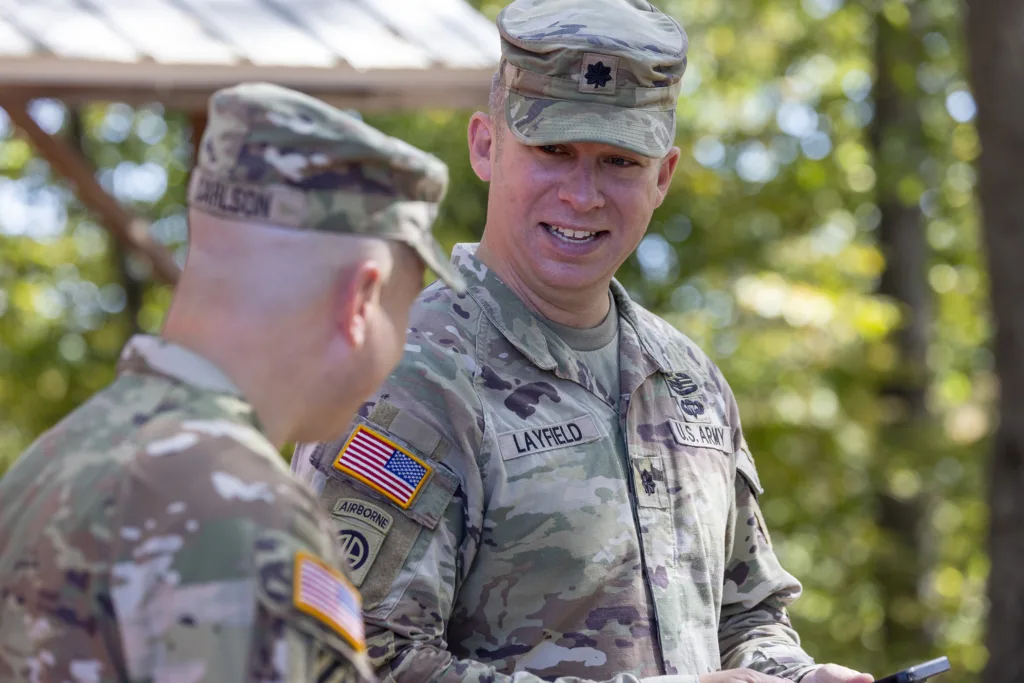
“We are the pathway for somebody who wants to join the Army as a commissioned officer, and I want to facilitate their ability to achieve that goal,” Layfield said.
Between their junior and senior year, every cadet contracted to join the Army after graduation travels to Fort Knox, Kentucky, for 34 days of training. Students are evaluated against cadets throughout the nation while completing tasks such as rifle marksmanship, land navigation, platoon level (the smallest military unit led by a commissioned officer) and leadership roles. A majority of UGA Army ROTC cadets are ranked in the “outstanding” or “excellent” categories, which is higher than at most universities, according to Layfield.
“I’m looking for two things when recruiting cadets: a willingness to learn and understand that you don’t know everything, and a selfless mentality,” Layfield said. “If a lieutenant or senior cadet has those two things, they’re going to end up being successful because the Army is built to teach them on the job. But they need to have that mentality.”
Three things that Layfield preaches to his cadets are physical fitness, academic excellence and integrity. He wants them to feel passionate and prepared as they enter their first jobs, typically platoon leader positions supervising between 15 to 40 soldiers.
Layfield hopes to continue growing the UGA Army ROTC every year, looking for cadets with a willingness to learn and be servant leaders. Currently at 73 (up from 57 cadets in spring 2024), Layfield’s goal is to reach 100 cadets in the coming years, while maintaining the program’s quality. He also hopes to reach more UGA students and let them know there is a pathway for anyone interested in the military, whether that be as a doctor, lawyer or combat leader.
“I love working with soldiers, and I love working with cadets,” Layfield said. “I want every one of our cadets who commissions through our program to take charge in the Army and be the best they can be.”