

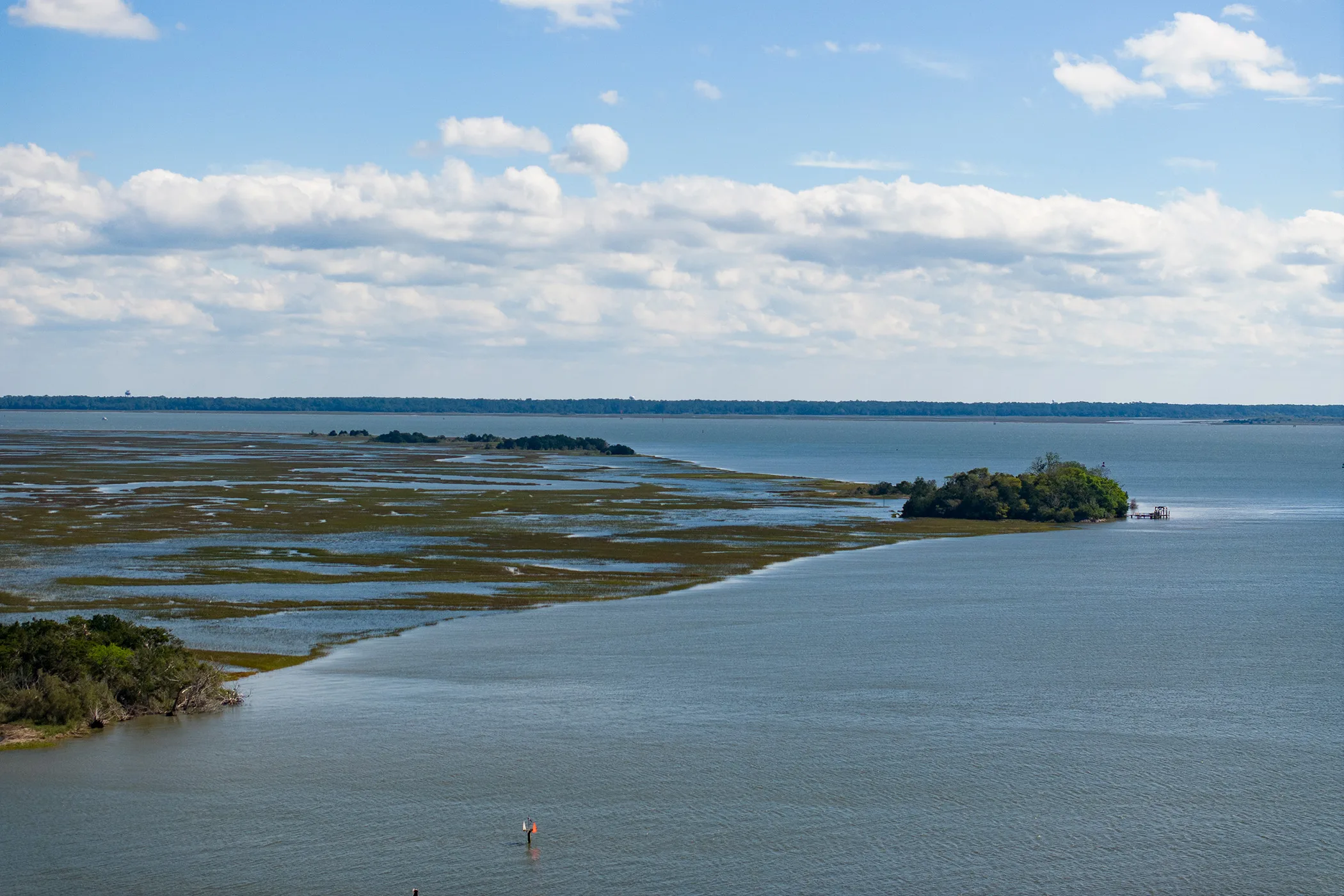
The University of Georgia has been awarded an $8 million grant from the National Oceanic and Atmospheric Administration Fisheries to lead a three-year regional initiative to restore salt marsh habitat across the South Atlantic from North Carolina to Florida. The project is one of 16 habitat restoration projects selected by NOAA out of nearly 350 nationwide proposals.
As salt marshes face threats from rising sea levels, coastal development and pollution, the project will evaluate using dredged sediment, which is material removed from navigational waterways, to restore marshes. Typically, dredge material is deposited in containment areas, dumped miles offshore or used for beach nourishment. Keeping dredged sediment in the system and applying it directly to nearby marshes will raise marsh elevation, facilitating plant growth and enhancing habitat.
UGA Marine Extension and Georgia Sea Grant proposed the effort as part of the South Atlantic Salt Marsh Initiative (SASMI), a regional collaborative of more than 300 partners seeking to protect and restore marsh along the South Atlantic coastline. Georgia contains 368,000 acres of the nearly 1 million acres of marsh in the region.

“Working through SASMI allows UGA to bring science and multistate coordination together to restore these critical coastal ecosystems across state lines,” said Mark Risse, primary investigator on the project and director of UGA Marine Extension and Georgia Sea Grant. “Salt marshes serve as vital nursery grounds and habitat for fish and wildlife. They filter pollutants and protect communities from storms and flooding by buffering wave energy.”
UGA will work with key partners, including Florida Atlantic University, Audubon South Carolina and the University of North Carolina at Chapel Hill, to lead teams in each state through a multiyear approach that involves planning, data collection, design, permitting and community outreach. At the end of the project, each state will have engineering designs for the proposed project sites, which include:
- Bird-Long Island, Georgia
- Cape Lookout National Seashore, North Carolina
- Cape Romain National Wildlife Refuge, South Carolina
- Julia’s Island, Florida
Once implemented, these state-based projects have the potential to restore a total of 326 acres of salt marsh across the region. By developing standard marsh restoration practices using dredge material across multiple sites, UGA and SASMI partners aim to establish a reusable blueprint for this natural infrastructure approach to marsh restoration that can build resilience in coastal communities across the Southeast and nationally.