

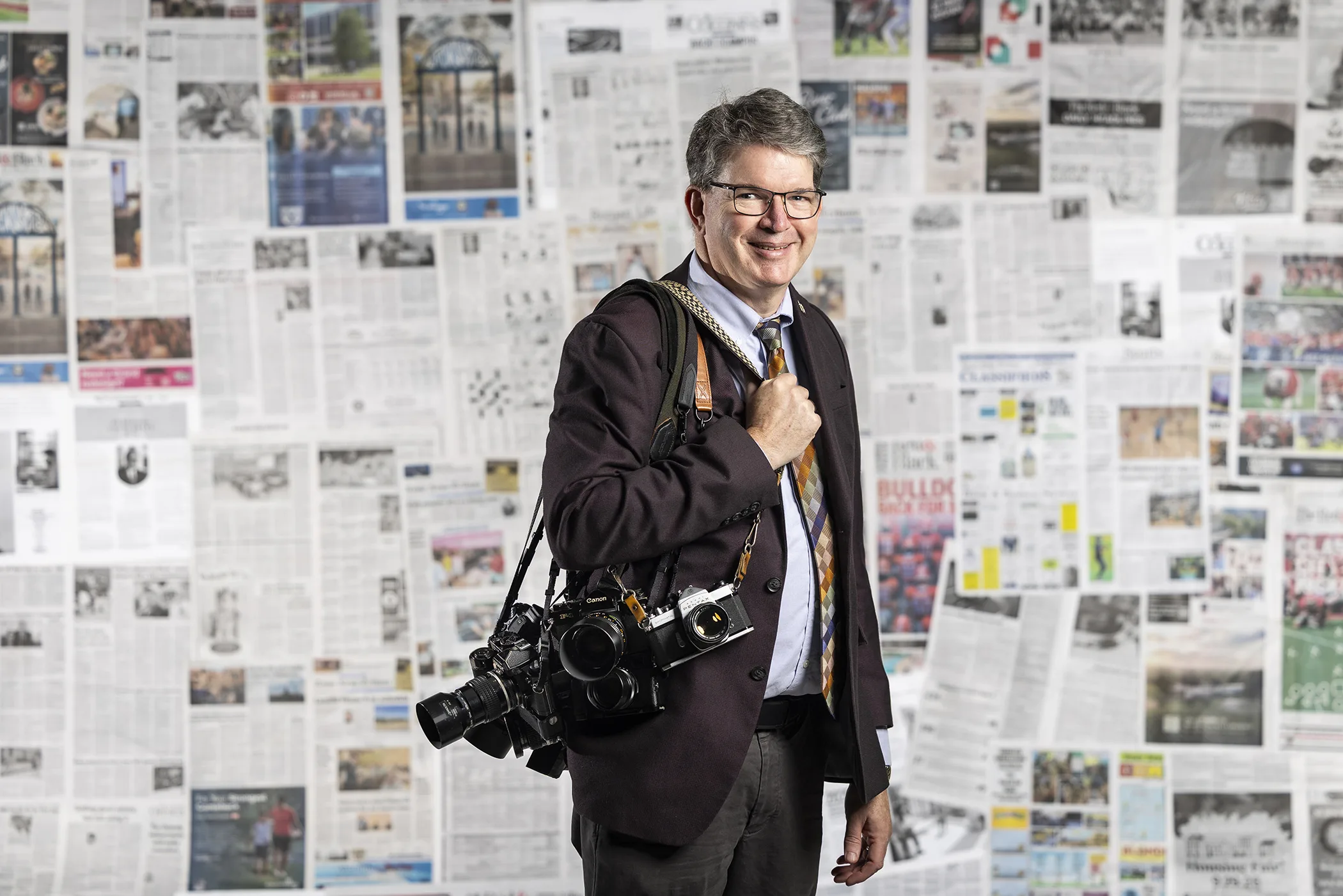
Mark E. Johnson started looking through the lens of a camera at a young age, but his calling as a photojournalism professor didn’t come into focus until later in life.
Johnson’s mission as a University of Georgia professor is to teach his students more than the mechanics of a good photograph.
“A great photograph stops you, and it makes you think,” Johnson said. “It makes you ask questions. It makes you feel something. And, ultimately, it helps connect the viewer, through the photojournalist, to the person in that photograph.”
Johnson grew up around photography thanks to his father who was an amateur photographer, using pictures as a means of triggering memories and sharing stories. Johnson was also fascinated at a young age by the technical aspect of photography. He owned his first point-and-shoot camera by the time he was 7 years old, and when he was 11, he worked a paper route to earn money for his first 35mm camera.
Johnson feels a calling to journalism as strongly as photography. He realized the impact of community journalism through work on the yearbook and a cable TV access news program when he was in high school, which led to a photojournalism career at community newspapers and magazines out of college. In 1993, he began freelancing for The Associated Press, which eventually led to coordinating the organization’s photo operations for the state of Rhode Island.
“I see journalism as a public service,” he said. “It’s a calling. If a community understands itself, it can make better decisions.”
It wasn’t until Johnson returned to college and worked as a teaching assistant that a career in education came into focus.
“A student came in on a Monday morning holding film in her hands that she had processed over the weekend. Her eyes were huge, and she said, ‘I get it.’ We sat down, and we looked through those five rolls of film and everything we had talked about in class showed up. I knew at that moment I wanted to teach.”
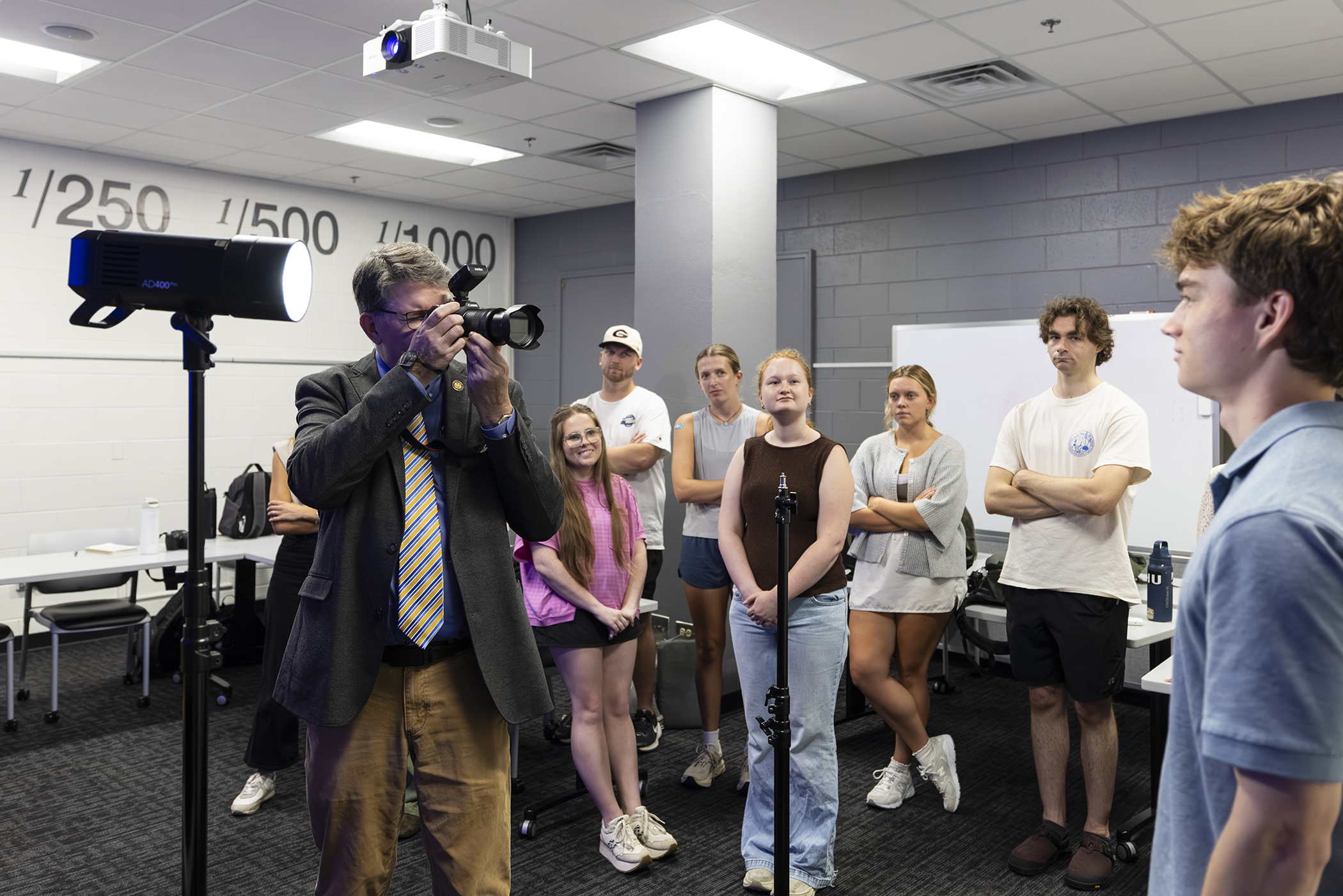
It was in Johnson’s first year teaching at UGA that he created an experiential learning program for his students that evolved into the Photojournalism at the Fair program at the Georgia National Fair, which celebrated its 20th year last fall. Johnson, now the John G. Alston, Sr., Professor of Sports Media, has also taught the documentary photojournalism course since that first year, leading students to a rural county in Georgia for the Woodall Weekend Workshop each spring where students document the stories and culture of the community.
“Successful photojournalism is about being present,” Johnson explained. “It’s about bearing witness. It’s all about listening and immersing yourself in the story. A successful photojournalism education is about experiencing things for the first time or from a different perspective in an environment where you can practice, fail and try again.”
That quest for experiences has also led Johnson to direct students on a variety of experiential learning opportunities from covering Friday night football and those county fairs to covering the impact of changing weather patterns on timber forests around the state. He has also worked with his colleagues in the Grady College of Journalism and Mass Communication’s John Huland Carmical Sports Media Institute to build programs photographing the 2023 Women’s World Cup in Australia, the 2024 Paralympics in Paris and, most recently, the 2026 FIFA World Cup in Monterrey, Mexico — all in partnership with The Associated Press.
Currently, Johnson teaches “Introduction to Photojournalism” and “Advanced Photojournalism” courses and is developing a new sports photojournalism course that starts next spring.
Beyond teaching, Johnson is instrumental in shaping the photojournalism industry through his involvement with the National Press Photographer’s Association. NPPA has its headquarters at UGA, as well as its Best of Photojournalism competition and archives. Both of which were moves that Johnson helped orchestrate in 2015.
He keeps his own skills sharp by taking at least one photo a day and posting it online, a practice he has maintained for nearly 16 years without missing a day.
A love for technology that Johnson developed as a child has followed him through his life as well. In addition to his teaching responsibilities, Johnson serves as the chief technology officer for Grady College and directs many of the college’s renovation projects. Johnson also serves on the University Council Information Technology Committee.
“It’s all about providing a better experience for the kids,” he said about the service work. “But, I will drop everything else when a student says they need help.”