

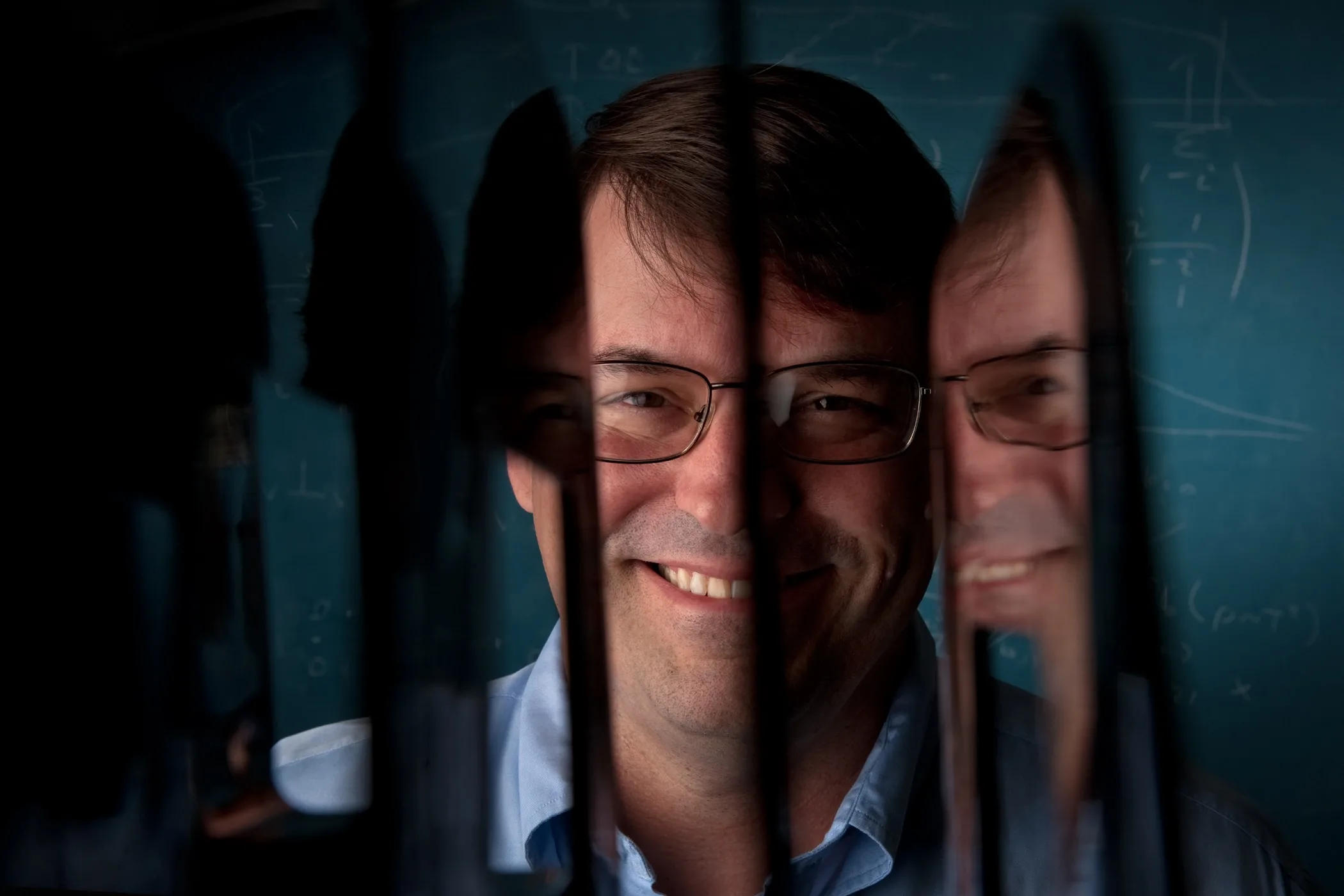
Steven R. White, Distinguished Professor of Physics and Astronomy at the University of California, Irvine, and one of the world’s leading physicists, will deliver the 2026 Chhabra-Landau Lecture at the University of Georgia on Feb. 26.
Hosted by UGA’s Center for Simulational Physics, White’s talk is part of the 2026 Provost’s Seminar Series, which features prominent members of the National Academies of Science, Engineering and Medicine and the American Academy of Arts and Sciences. The lecture will be held at 2:55 p.m. in the Physics Building, room 202, and is free and open to the public. A light reception will follow the lecture.
“I’m excited that Dr. White’s presentation is not only a part of the highly regarded Provost’s Seminar Series but also the Chhabra-Landau Lecture Series on computer simulations, which has brought many prominent scientists to UGA to showcase the role of computation in understanding and predicting complex phenomena in nature,” said Phillip Stancil, head of the department of physics and astronomy in the Franklin College of Arts and Sciences.
White is a condensed matter physicist who specializes in the simulation of quantum systems, a physical entity — such as an atom, electron or photon — whose behavior is governed by the principles of quantum mechanics rather than classical physics. He is particularly known as the inventor of the Density Matrix Renormalization Group, a pioneering approach for simulating quantum systems in several areas of physics and chemistry, and the first tensor network algorithm. White is a recipient of the Aneesur Rahman Prize in Computational Physics, the highest honor presented by the American Physical Society for work in the field. He is a member of the American Academy of Arts and Sciences and the National Academy of Sciences.
White’s lecture, “Combining Monte Carlo and Tensor Networks to Beat the Quantum Exponential,” will provide elementary introductions to both Monte Carlo simulations and tensor networks and describe two different problems where scientists combined the power of these approaches to make substantial progress.
For more information about the lecture, contact Phillip Stancil.