

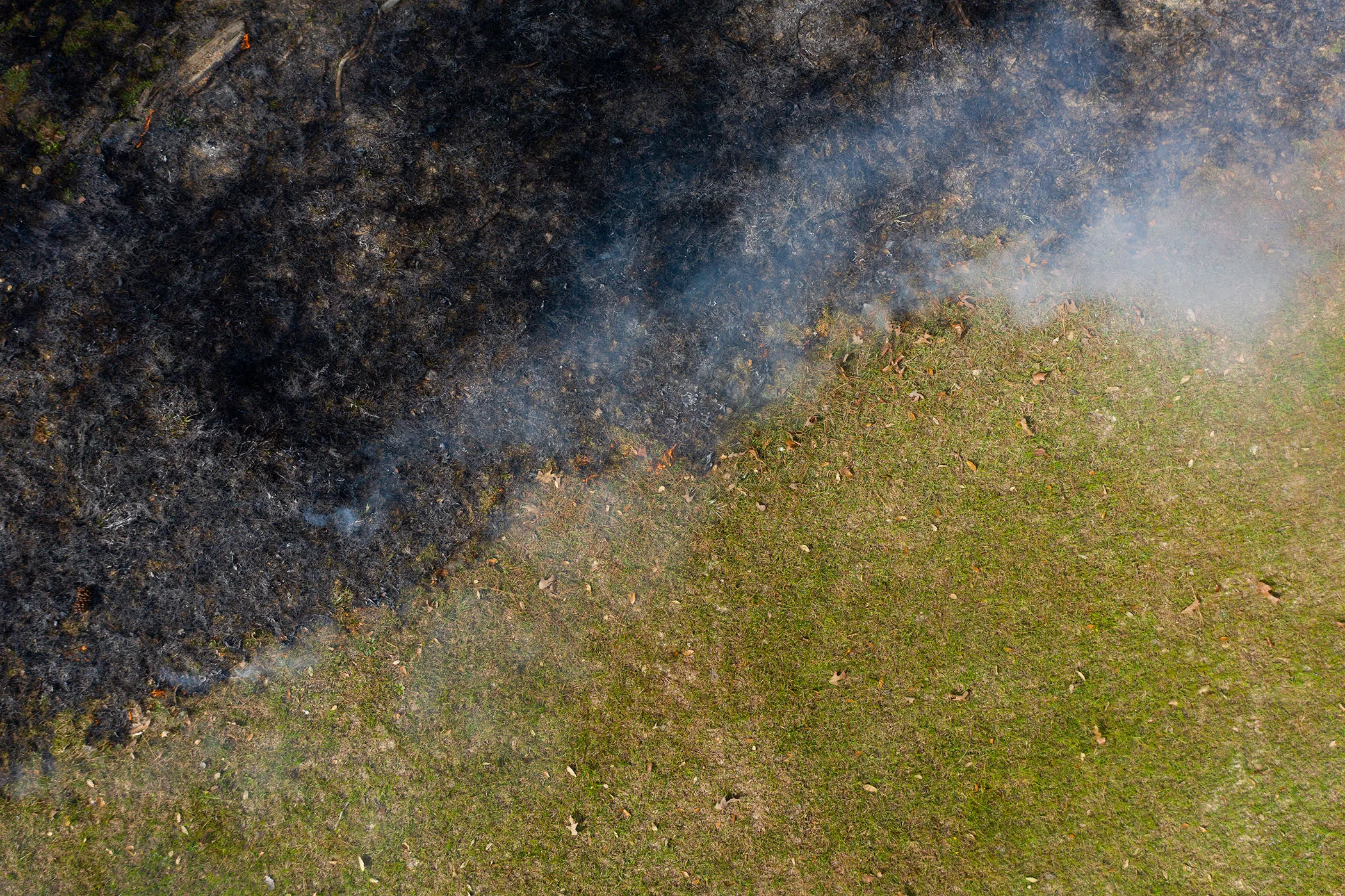
Prescribed fires are vital for reducing wildfire risk and sustaining forest biodiversity. But they also contribute significantly to air pollution and smoke exposure, according to new research from the University of Georgia.
The issue is especially pertinent to the southeastern United States, where 60% of all prescribed fires across the country occur. More than 20% of the fine particle pollution in the southeastern U.S. can be attributed to prescribed burns, the study found.
Wildfires and prescribed burns of forested areas both generate what’s known as fine particle pollution. Also referred to as soot, this type of pollution consists of tiny solid and liquid particles that are small enough to be inhaled and enter the bloodstream.
We need to understand how prescribed fire smoke affects nearby communities.
Jingting Huang, College of Engineering
Exposure to fine particle pollution is a major public health threat that can lead to a variety of health problems, including cancer, heart attacks and asthma, among others.
“Prescribed fire is receiving more attention because it is increasingly viewed as an important climate-adaptation tool to reduce wildfire risk and maintain biodiversity,” said Jingting Huang, lead author of the study and a postdoctoral researcher in UGA’s College of Engineering. “But as its use expands, we also need to understand how prescribed fire smoke affects nearby communities.”
Georgia experiences 40 smoke-impacted days annually
The researchers analyzed state burn permit records from Georgia, Florida and South Carolina, using a multistage air quality model to capture thousands of small, short-lived prescribed burns often overlooked by satellites or federal fire inventories.
The study found that Georgia experiences the highest population exposure to fine particle pollution with over 40 smoke-impacted days annually. On those days, smoke from prescribed fires increased the amount of pollution people inhaled even when overall air quality didn’t reach hazardous levels.
Many of Florida’s burns were located away from heavily populated areas, reducing the amount of smoke to which residents were exposed. South Carolina had less burned area overall.
This is important because we would like to maximize prescribed fire use for conservation while also reducing people’s exposure to smoke.
Christina Fuller, College of Engineering
The differences in the smoke impacts can be attributed to where and how often the burns occur relative to state population centers, the researchers said.
“We can use this new model to estimate the impacts of policy changes on fine particle matter concentrations and people’s exposure,” said Christina H. Fuller, co-author of the study and an associate professor of engineering at UGA. “This is important because we would like to maximize prescribed fire use for conservation while also reducing people’s exposure to smoke.”
Study uses burn permit records to account for often-missed smaller fires
The study is the first to put state burn permit records at the center of the smoke modeling process. Many small-scale, low-intensity prescribed fires in southeastern states are challenging for satellites to detect.
Although states often collect permit information, those records have not always been brought together in a way that can be directly used in air quality models.

The present study suggests that detailed permit records can provide a clearer picture of prescribed fire activity than satellite-based inventories alone. But this approach may not work everywhere.
“In regions where permit records are incomplete, unavailable or not comparable across jurisdictions, satellite observations remain essential for tracking fire activity and estimating smoke impacts,” said Holly Nowell, co-author of the study and director of the smoke science program at Tall Timbers, a research station and land conservancy.
“One exciting aspect of this study is that we’ll now be able to simulate how individual landowners — and potentially new burn policies — can reduce smoke impacts overall,” said Jeffery Cannon, co-author of the study, a research scientist at The Jones Center at Ichauway and adjunct faculty in UGA’s plant biology department.
The study was published in Geophysical Research Letters.