

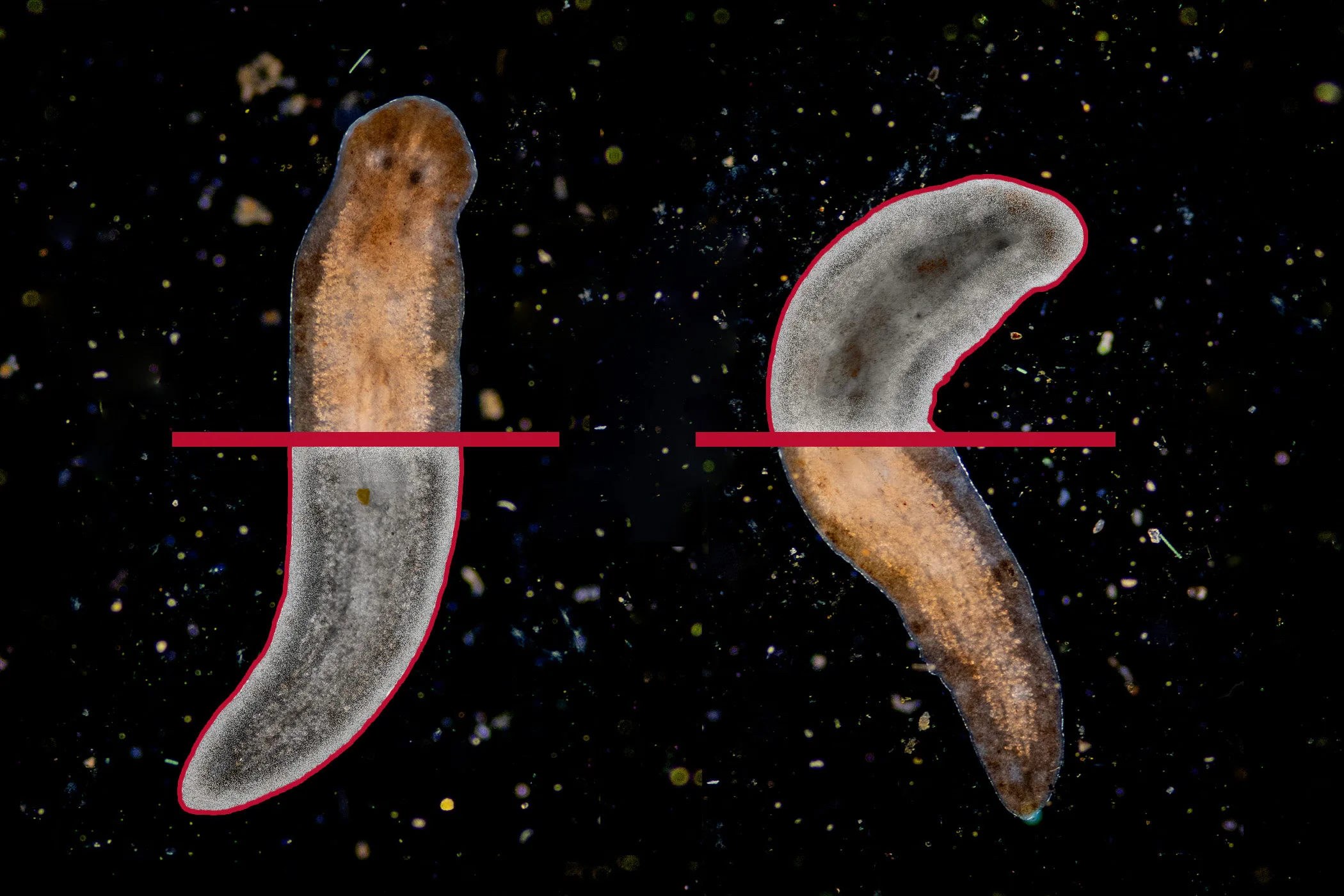
The human brain is terrible at healing itself from injury or disease.
But some animals can harness their own cellular abilities to not only repair injuries but also to regrow their brains entirely. Researchers from the University of Georgia have pinpointed several of the genes that make brain regeneration possible in one type of flatworm.
“Big picture: We would like to come up with ideas for how to better empower the human brain to regenerate itself,” said Rachel Roberts-Galbraith, corresponding author of the study and an associate professor in UGA’s Franklin College of Arts and Sciences. “The understanding of brain regeneration that we can develop using simple animals gives us a reason to be optimistic. It’s not an inherent property of brains that makes them bad at regeneration. It’s something specific to humans.”
Both flatworm and human brains are made up of networks of specialized cells called neurons. These cells communicate with each other by sending electrical or chemical signals. Some neurons react to stimuli, such as light or touch, while others control movement.
Flatworms use stem cells to replace neurons after injury. Humans also have stem cells, but they are unable to transform into new neurons effectively enough to heal injuries. The new study sheds light on how shared genes work in flatworms and lays the groundwork for researchers to investigate similar pathways that might be activated in humans to design better therapies for traumatic brain injuries or diseases.
Some flatworms can regrow tissues, muscles, even their brain
Planarians can be found in freshwater, salt water and even on land. They don’t have circulatory or respiratory systems. But they do have stem cells that can change into whatever their body needs at a given time, making them a valuable animal of study for brain and cognitive research.
Using stem cells, planarians can regrow their entire body from just a sliver of a body fragment. They can rebuild tissues, muscles and even their brain.
But how do these tiny creatures know what type of cell to make and where to send it?
Published in Nature Communications, the study identified almost a dozen genes responsible for instructing stem cells to turn into dopamine-producing neurons and directing those new neurons to the right locations in the worm’s body. These neurons are also present in humans and other animals.
Known as the “feel good” chemical, dopamine is more than just the brain’s reward and pleasure chemical. It also acts as a signal to help neurons communicate with one another and plays a key role in controlling movement. People with Parkinson’s disease, for example, experience tremors and stiffness due to low levels of dopamine.
Big picture: We would like to come up with ideas for how to better empower the human brain to regenerate itself.
Rachel Roberts-Galbraith, Franklin College of Arts & Sciences
When the researchers knocked out some of the genes discovered in this study, they found the planarians struggled to make new dopamine-producing neurons and also experienced slow movement, similar to the effects of low dopamine in people and other mammals.
Currently, healthcare providers don’t have many options to treat conditions like Parkinson’s, Alzheimer’s or traumatic brain injuries. Harnessing the body’s own cells in the same way planarians do to heal wounds would be a game changer.
“We figured out the genetic recipe for making these cell types in planarians,” Roberts-Galbraith said. “We’re hoping this work helps others figure out how to create dopamine-producing neurons from stem cells that can be more effectively transplanted into patients.”
Roberts-Galbraith’s lab in the department of cellular biology is part of UGA’s Regenerative Bioscience Center, an interdisciplinary research hub focused on the potential of regenerative medicine. The study was co-authored by first authors Kendall Clay and Taylor Medlock-Lanier, as well as co-authors Rachel Grimes, Olabamibo Oke, Brice Hudson, Macey Wilson and Nikolay Filipov.