

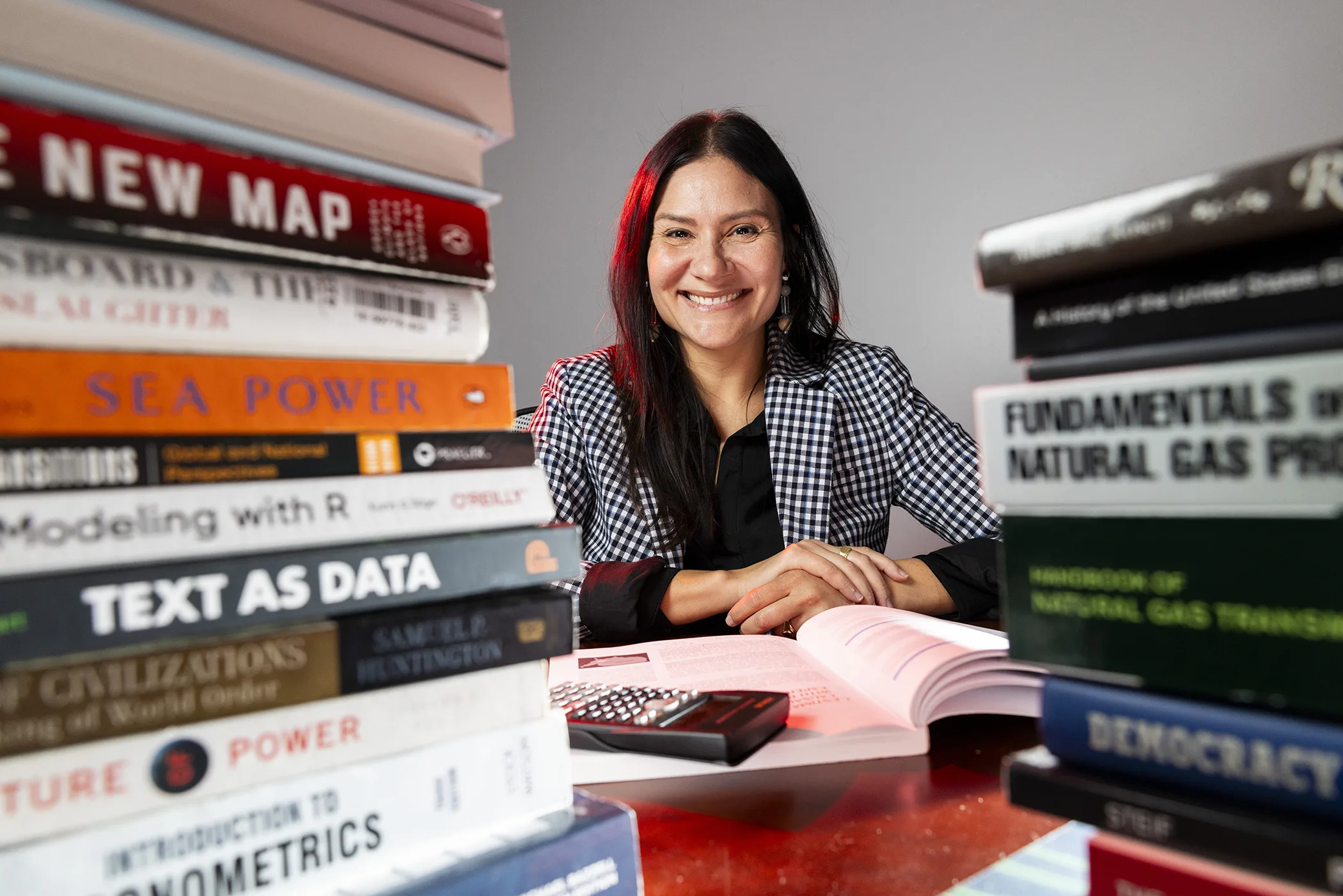
For Camila Livio, ordinary is not in her job description.
“Never in my life did I imagine that I would be talking about or thinking about energy, power generation and other related topics such as lethal autonomous weapon systems,” she said. “Yet here we are.”
Before coming to the U.S., she studied in different countries and has always been fascinated by foreign languages. Originally, Livio arrived in the U.S. as a Fulbright Scholar teaching Portuguese at the University of Pennsylvania and went on to earn a Ph.D. in linguistics from University of Georgia. That training has served her well beyond that field.
“Much of modern American sociolinguistics research is quantitative and computational, which prepared me well to apply similar research designs in other fields,” she said.
As a research associate with the Energy Security Studies Program, housed at the Benson-Bertsch Center for International Trade & Security in the School of Public and International Affairs, she works with data and teaches a course on Data Analytics and Presentation in the Master of International Policy.
Her days are filled with loading numbers and words into her computer and analyzing results, and her current research revolves around energy and power generation. Her training as a sociolinguist allows her not only to interpret those results but also to place them in a broader context.
“Sociolinguistics is about understanding variation: who does what, where and why,” Livio said. “When I look at energy demand across the U.S. and internationally, I’m asking the same kinds of questions.”
Through the course she teaches, she inspires students to code, think about programming and large language models, and use these resources to their advantage for quantitative public and foreign policy work. Many of her students want to follow in her footsteps with her interdisciplinary approach to research.
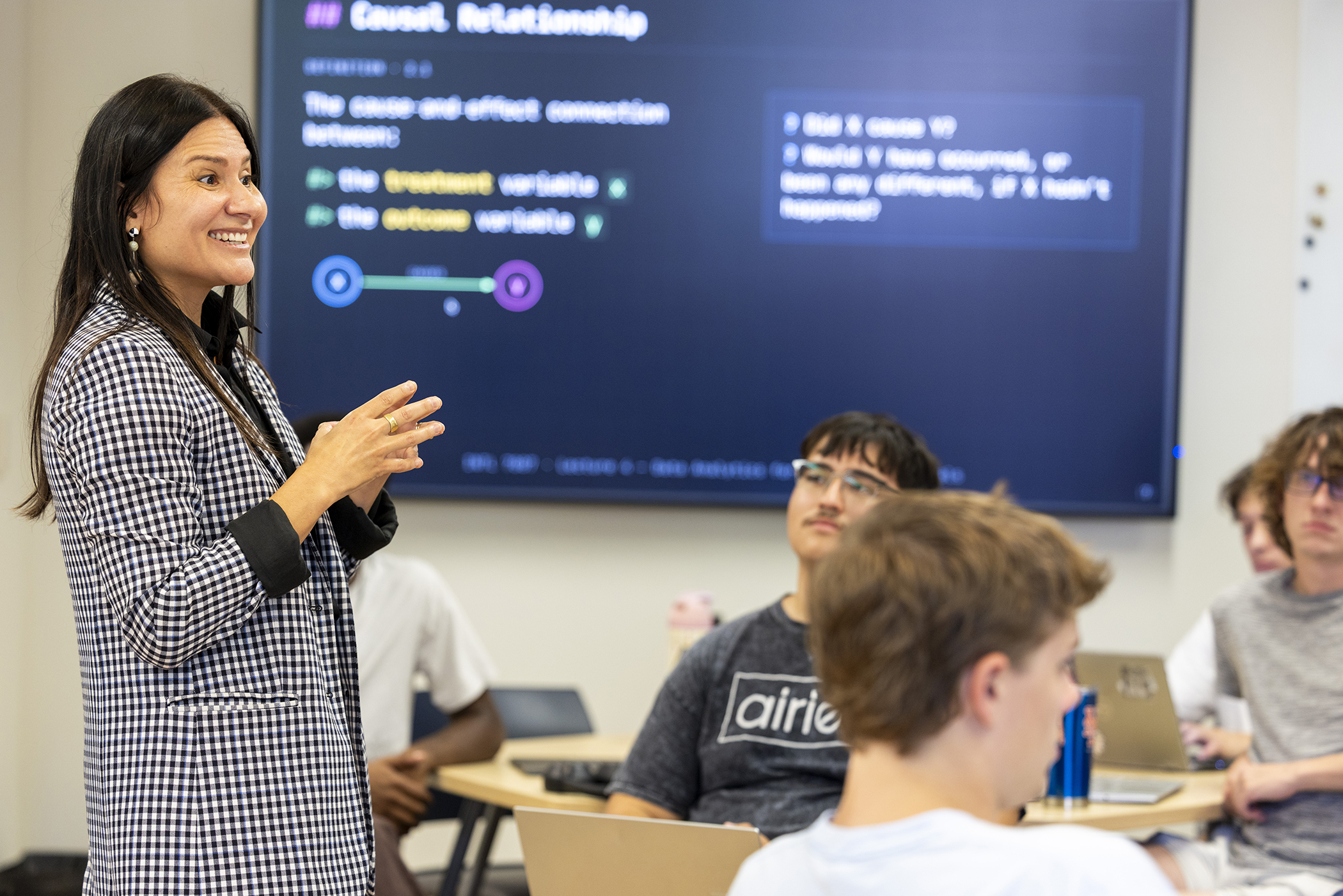
Livio is especially interested in discussions on digital communities, such as Reddit and Bluesky, about how people discuss different energy sources, as well as their perspectives on topics such as data centers. She said that treating words as data points allows the team to map public attitudes and expectations.
“I feel like I’m constantly learning, which is also really nice about my job. And my colleagues are so supportive — it makes a real difference,” Livio said.
With help from her team and SPIA, she communicates with members of the public, policymakers, county officials and researchers around Georgia and the country to further the research and knowledge around energy.
“Everybody has an energy bill to pay, and this intersects with topics that are very relevant for our times,” Livio said. “And so, I just want to continue to be able to communicate our research across sectors.”
One of her goals is to make research on this subject more accessible to the public. She recently presented this research with colleagues, taking up both the promise and the strain AI places on the power grid.
When Livio is not in her office, she can be seen biking around Athens, listening to a local band and spending time with her family and friends. For Livio, getting out in town is also a way to build relationships in the Athens community.
“I like to be out and about town,” she said. “I like everything and anything that relates to music, and Athens has so much to offer.”