

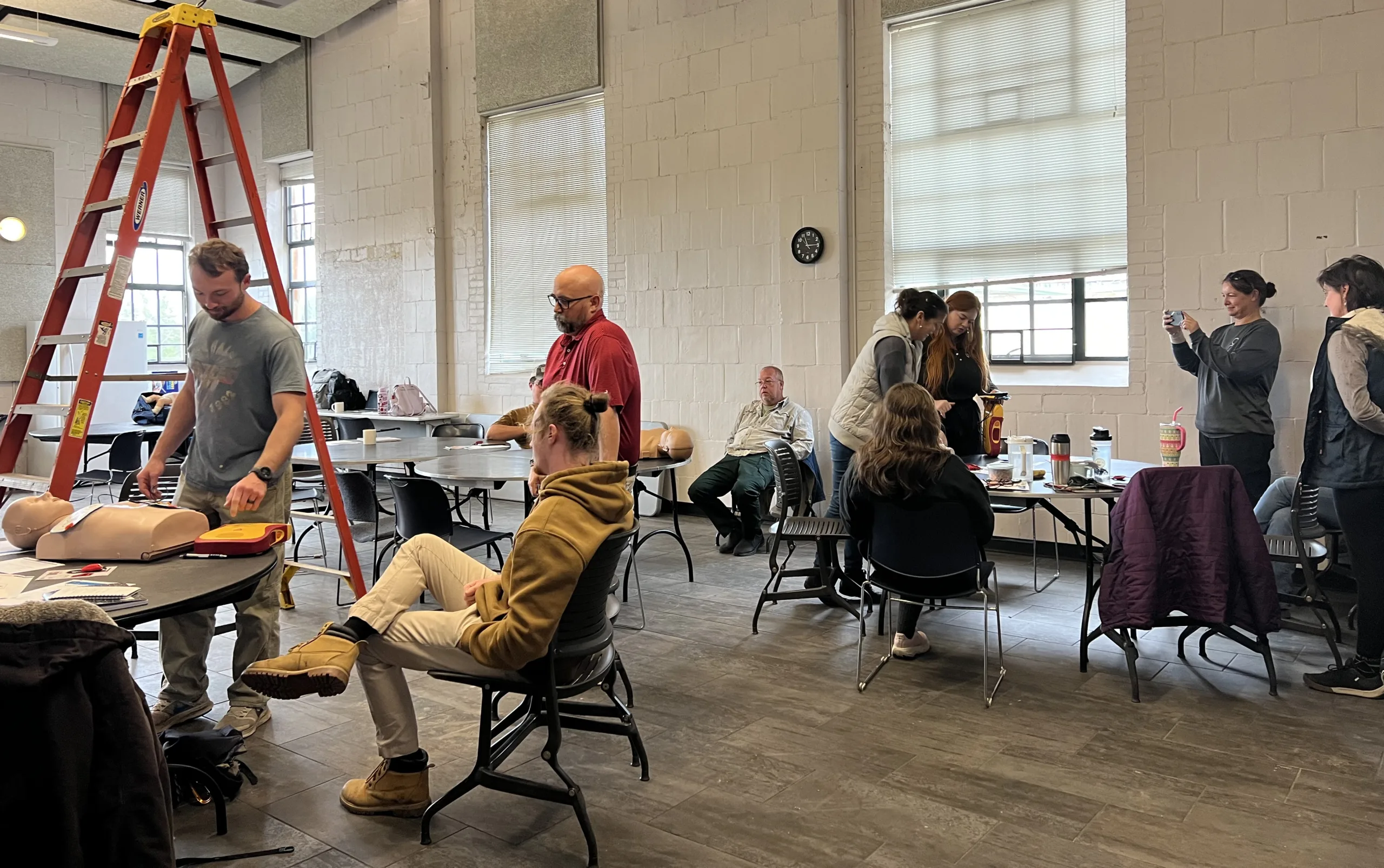
On a recent humid morning at the State Botanical Garden of Georgia, summer camp counselors learned what to do if they see someone suffering from cardiac arrest.
After reviewing the signs of cardiac arrest with instructors Noelle Broadnax and Alex Nichols from the University of Georgia’s Office of Emergency Preparedness, the counselors took turns practicing chest compressions on mannequins.
Throughout the day in the botanical garden classroom, the counselors learned other lifesaving skills — including the use of automated external defibrillators and how to treat a bleeding limb.
“What we’re teaching here is how to manage a medical emergency to the best of your ability until help arrives,” Nichols told the counselors, who include current UGA students and recent graduates.
This annual training is essential for the camp counselors, said Audrey Mitchell, the children’s program coordinator at the botanical garden.
“We are taking care of these kids 40 hours each week,” Mitchell said. “Not only should our counselors be prepared, but we also can reassure parents that their children will have a safe and fun camp experience.”
Broadnax, Nichols and their colleagues share this lifesaving wisdom dozens of times every year across the state of Georgia.
By the end of the 2025-26 academic year at UGA, emergency preparedness staff will facilitate more than 150 training sessions for hundreds of employees and students on UGA’s campuses in Athens, Griffin, Tifton, Gwinnett and Buckhead as well as research and University of Georgia Cooperative Extension facilities statewide.
Sessions cover a wide range of topics, including CPR/AED training, Stop the Bleed and Civilian Response to Active Shooter Events. Additional staff from the UGA Police Department and the Office of Public Safety also facilitate training.
Members of these campus communities benefit from training in ways well beyond the specific skills they learn during these sessions, said John Heinen, UGA’s director of the Office of Emergency Preparedness.
This is especially important, Heinen added, during hurricane season. The official start of the 2026 hurricane season for the Atlantic Ocean began on June 1 and runs through Nov. 30.
Citing data from the National Hurricane Center, Heinen noted that Hurricane Helene, which struck the Southeast in September 2024, caused at least 250 fatalities including at least 37 deaths across Georgia.
“Any type of first responder training enables our colleagues to be better prepared for any emergency they might encounter,” Heinen said. “This contributes to an overall state of readiness that is crucial when lives are at stake.”
Nick Macias, assistant director for operations at the UGA Marine Institute on Sapelo Island, said he and his colleagues work frequently with emergency preparedness, “especially as we get closer to hurricane season.”
The training that OEP provides to Macias and his colleagues “is really helpful … especially in stressful situations when there are a lot of moving pieces.”
Elizabeth Laney, an executive assistant in the Office of the Assistant Provost and campus director in Griffin, works with emergency preparedness staff to facilitate training on her campus. Laney and her Griffin colleagues hope their emergency skills will never be needed.
But if called upon, they will be ready.
Laney cited the Griffin campus’ response to the Jan. 12, 2023, tornado that struck the campus and surrounding Spalding County.
“Most of the OEP trained responders were on site that day. We had four or five in our building,” she said. “I know firsthand that the training I’ve had here certainly gave me more confidence.”
Thanks to these sessions, “our faculty and staff can really take care of their own community during an emergency — whatever that emergency might be,” Laney added.
“Our students are also really interested in getting training. Not only do they want it for when they’re in school, they also want it for when they graduate and move on to their careers,” she said. “We are so fortunate to have trainers trek down from Athens to the Griffin campus a couple of times per year.”
Additional training sessions range from basic emergency preparedness to safety, security and emergency planning for international travel.
Students, faculty and staff can view OEP training courses at prepare.uga.edu/training and request a course by completing this form.
More information, including how to sign up for training, can be found on the Stay Safe UGA website.